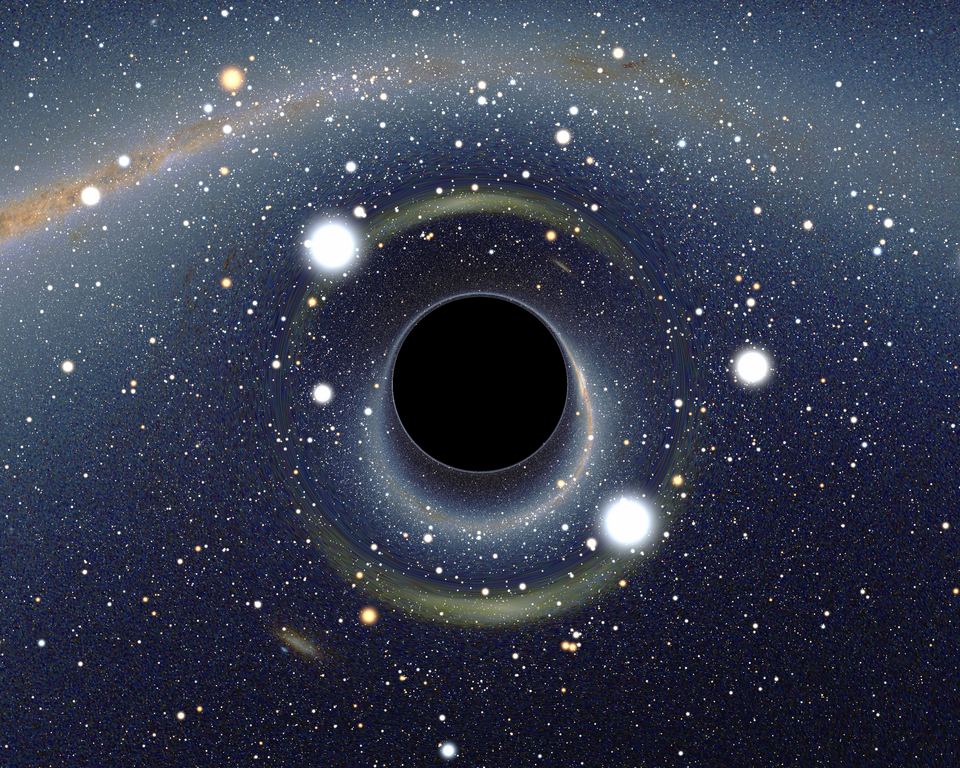
Supermassive Black Holes: Assembled, Not Born From Stellar Collapse
The Gist
Analysis of black hole mergers suggests the largest black holes grow through repeated collisions in dense star clusters.
Explain Like I'm Five
"Imagine tiny black holes bumping into each other again and again in a crowded playground, eventually becoming giant black holes!"
Deep Intelligence Analysis
The key evidence lies in the spin patterns of the most massive black holes. Unlike black holes formed directly from stellar collapse, which tend to have slow and aligned spins, the heaviest black holes exhibit rapid spins pointing in seemingly random directions. This signature indicates that they have undergone multiple mergers, tumbling through space and colliding repeatedly in the dense cores of globular star clusters.
Furthermore, the study confirms the existence of a mass gap around 45 times the mass of the Sun, where stellar black holes are rarely found. This gap is attributed to the fact that very massive stars tend to detonate before collapsing into black holes. Black holes exceeding this mass threshold are likely second or third-generation objects, the products of cluster dynamics rather than stellar death.
These findings have significant implications for our understanding of galaxy evolution. Supermassive black holes play a crucial role in shaping the properties of galaxies, and their formation mechanism is closely linked to the evolution of their host galaxies. By unraveling the mysteries of black hole formation, we can gain deeper insights into the processes that govern the evolution of the universe.
*Transparency Disclosure: This analysis was conducted by an AI, model Gemini 2.5 Flash, and is intended for informational purposes. The AI has been trained to provide objective insights based on the provided source content.*
_Context: This intelligence report was compiled by the DailyOrbitalWire Strategy Engine. Verified for Art. 50 Compliance._
Impact Assessment
This research challenges the traditional view of black hole formation. It highlights the role of dense stellar environments in creating supermassive black holes. Understanding black hole formation is crucial for modeling galaxy evolution.
Read Full Story on Universe TodayKey Details
- ● Study analyzed 153 black hole mergers detected by LIGO, Virgo, and KAGRA.
- ● The most massive black holes show spin patterns indicating multiple mergers.
- ● Mergers occur in globular star clusters, where stars are densely packed.
- ● There's a mass gap around 45 times the mass of the Sun where stellar black holes are not found.
- ● Black holes above this mass are likely products of multiple mergers.
Optimistic Outlook
Improved understanding of black hole formation could lead to new insights into galaxy formation and evolution. Gravitational wave astronomy is proving to be a powerful tool for studying these phenomena. This research validates theoretical predictions about black hole mass gaps.
Pessimistic Outlook
The complexity of black hole mergers makes them difficult to model accurately. Further research is needed to fully understand the dynamics of globular star clusters. The mass gap could pose challenges for current stellar evolution models.

The Signal, Not
the Noise|
Get the week's top 1% of space-tech intelligence synthesized into a 5-minute read. Join 25,000+ aerospace insiders.
Unsubscribe anytime. No spam, ever.