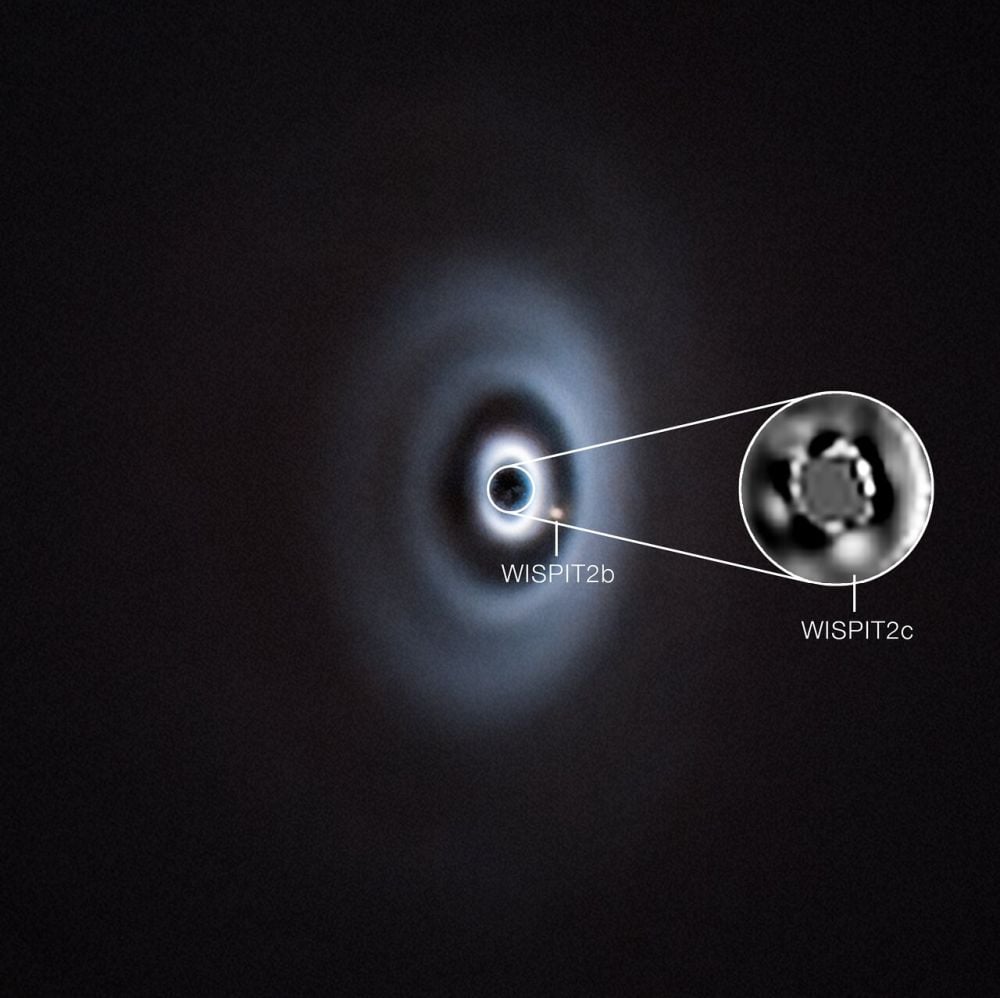
Two Baby Planets Confirmed Forming Around Young Sun-like Star
The Gist
Astronomers have directly confirmed the existence of two planets, WISPIT 2b and WISPIT 2c, forming around a young, Sun-like star called WISPIT 2.
Explain Like I'm Five
"Imagine a baby star like our sun, but much younger! Scientists found two giant baby planets growing around it. They're learning how planets are made by watching these babies!"
Deep Intelligence Analysis
_Context: This intelligence report was compiled by the DailyOrbitalWire Strategy Engine. Verified for Art. 50 Compliance._
Impact Assessment
The WISPIT 2 system offers a valuable analogue for understanding the early formation of our own solar system. Direct spectroscopic confirmation strengthens exoplanet models and provides insights into planetary composition.
Read Full Story on Universe TodayKey Details
- ● WISPIT 2c is estimated to be 8-12 times more massive than Jupiter.
- ● WISPIT 2c orbits at a radial separation of 14 AU from WISPIT 2.
- ● WISPIT 2 is approximately 5 million years old and 437 light-years away.
- ● Spectroscopic confirmation of WISPIT 2c detected carbon dioxide in its atmosphere.
Optimistic Outlook
The direct observation of planet formation provides valuable data for refining planet formation theories. Future observations of the WISPIT 2 system could reveal more about the atmospheric composition and orbital dynamics of young planets.
Pessimistic Outlook
Characterizing exoplanets, especially those still forming, remains technically challenging. The distances involved and the limitations of current observational technology could hinder further detailed analysis of the WISPIT 2 system.

The Signal, Not
the Noise|
Get the week's top 1% of space-tech intelligence synthesized into a 5-minute read. Join 25,000+ aerospace insiders.
Unsubscribe anytime. No spam, ever.