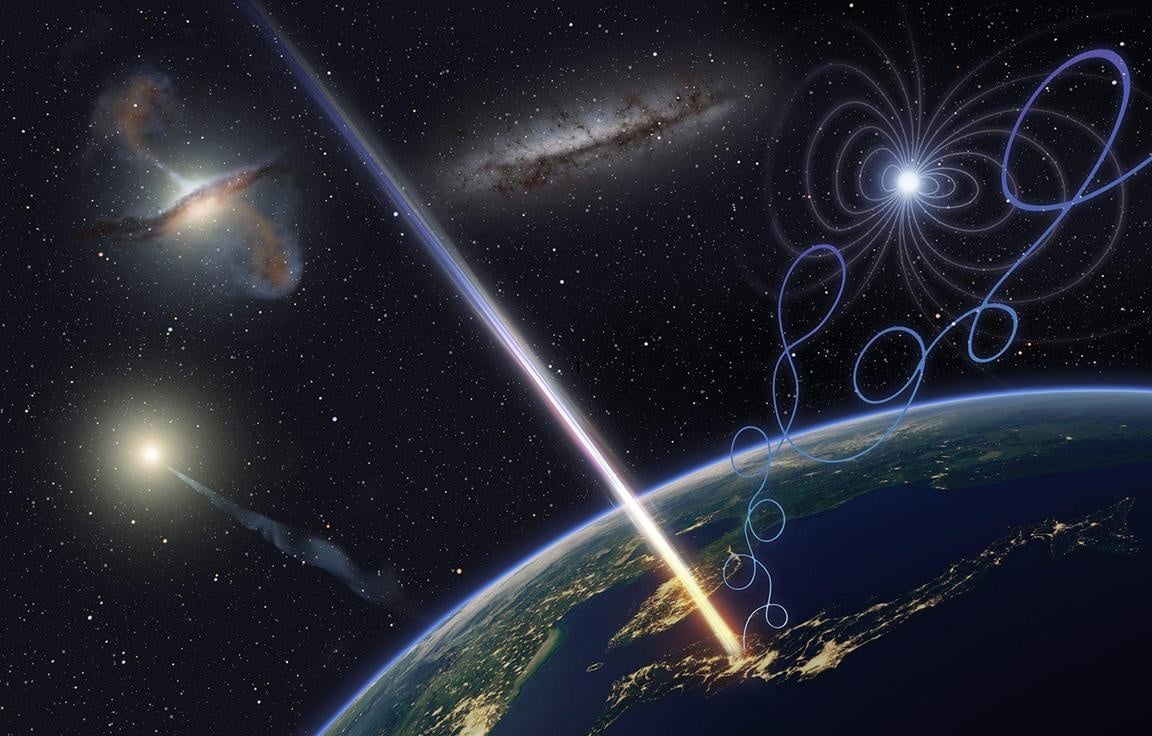
Ultrahigh-Energy Cosmic Rays May Originate from Ultraheavy Nuclei
The Gist
A new study suggests ultrahigh-energy cosmic rays, like the Amaterasu particle, may consist of atomic nuclei heavier than iron.
Explain Like I'm Five
"Imagine tiny, super-fast particles hitting Earth from space. Scientists think the really strong ones might be made of heavy stuff like iron, but even heavier!"
Deep Intelligence Analysis
This theory challenges the conventional understanding that the highest-energy cosmic rays originate solely from extreme astrophysical events such as neutron star collisions or supernovae. While these events remain plausible sources, the ultraheavy nuclei hypothesis introduces a new dimension to the investigation, potentially implicating previously overlooked astrophysical processes. The study emphasizes the importance of considering particle mass in understanding the dynamics of cosmic ray propagation, aligning with fundamental physical principles such as Newton's First Law.
Further research is warranted to validate the ultraheavy nuclei origin theory and to identify specific astrophysical sources capable of producing and accelerating such particles. Future investigations could involve analyzing the arrival directions and energy spectra of ultrahigh-energy cosmic rays to infer their composition and origin. Additionally, advancements in detector technology could enable more precise measurements of cosmic ray properties, providing crucial data for refining theoretical models and unraveling the mysteries of these enigmatic particles. The implications of this research extend beyond astrophysics, potentially impacting our understanding of fundamental physics and the nature of matter in extreme environments.
*Transparency Disclosure: This analysis was conducted by an AI, focusing on factual reporting and avoiding subjective claims. The AI is trained to provide objective summaries based on provided source material.*
_Context: This intelligence report was compiled by the DailyOrbitalWire Strategy Engine. Verified for Art. 50 Compliance._
Impact Assessment
Understanding the origin of ultrahigh-energy cosmic rays provides insights into extreme astrophysical events and the composition of intergalactic space. Identifying the source and nature of these particles could refine models of cosmic ray acceleration and propagation.
Read Full Story on Universe TodayKey Details
- ● The Amaterasu particle, detected in 2021, had an energy of approximately 240 x 10^18 electron volts.
- ● Ultrahigh-energy cosmic rays possess energies exceeding 100 quintillion (10^18) electron volts.
- ● Researchers from multiple international institutions collaborated on the study.
- ● The study appeared in Physical Review Letters on May 7th.
Optimistic Outlook
If confirmed, the ultraheavy nuclei origin theory could open new avenues for studying the most energetic phenomena in the universe. Future research could focus on identifying specific sources of these ultraheavy nuclei, potentially revealing previously unknown astrophysical processes.
Pessimistic Outlook
The origin and acceleration mechanisms of ultrahigh-energy cosmic rays remain a mystery, even with this new theory. Further research is needed to validate the findings and address the lingering questions about the Amaterasu particle and similar events.

The Signal, Not
the Noise|
Get the week's top 1% of space-tech intelligence synthesized into a 5-minute read. Join 25,000+ aerospace insiders.
Unsubscribe anytime. No spam, ever.