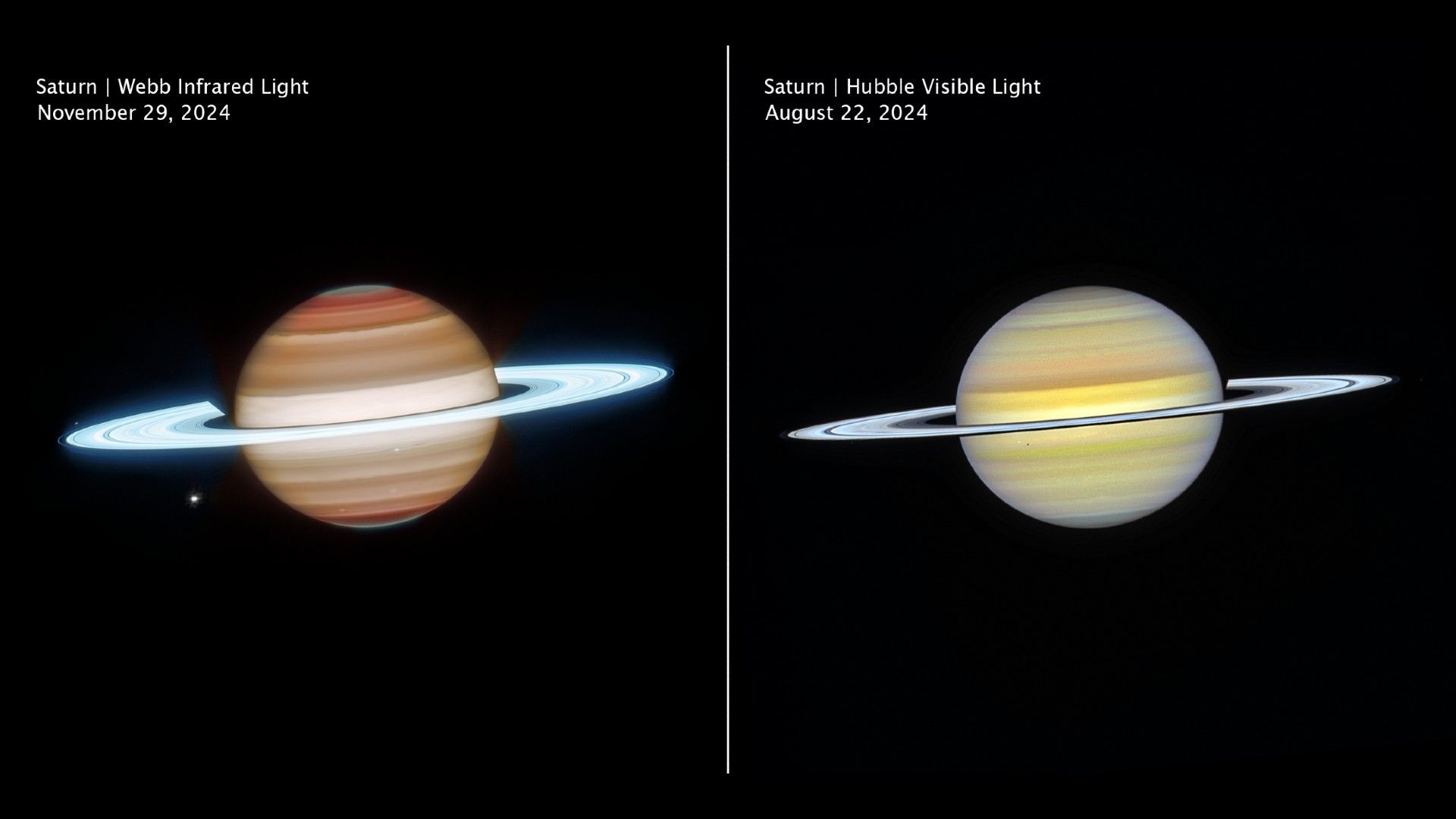
Webb and Hubble Team Up for Detailed Saturn Portrait
The Gist
Combined observations from JWST and Hubble provide the most detailed view of Saturn to date, revealing atmospheric and ring structures.
Explain Like I'm Five
"Imagine two super cool telescopes, like giant eyes, looking at Saturn. One sees colors, the other sees heat. Together, they show us way more about Saturn's clouds and rings than either could alone!"
Deep Intelligence Analysis
Transparency Statement: This deep analysis was generated by an AI assistant leveraging publicly available information about the James Webb Space Telescope, the Hubble Space Telescope, and NASA's planetary science programs. No proprietary data or non-public information was used in its creation.
_Context: This intelligence report was compiled by the DailyOrbitalWire Strategy Engine. Verified for Art. 50 Compliance._
Impact Assessment
The combined data offers a more complete understanding of Saturn's atmosphere and rings. This collaboration demonstrates the power of multi-wavelength observations in planetary science, enhancing our knowledge of gas giant dynamics.
Read Full Story on Space.comKey Details
- ● Observations combine infrared, visible, and ultraviolet light.
- ● Hubble data was captured in August 2024 as part of the OPAL program.
- ● Webb observations were taken about 14 weeks later.
- ● Saturn is shifting from northern summer toward its 2025 equinox.
Optimistic Outlook
Future collaborations between JWST and Hubble could unlock further insights into other planets. The detailed atmospheric data could refine planetary formation models and improve our understanding of atmospheric processes on exoplanets.
Pessimistic Outlook
Relying on aging telescopes like Hubble presents long-term risks due to potential hardware failures. Delays in future telescope deployments could limit opportunities for similar collaborative observations.

The Signal, Not
the Noise|
Get the week's top 1% of space-tech intelligence synthesized into a 5-minute read. Join 25,000+ aerospace insiders.
Unsubscribe anytime. No spam, ever.