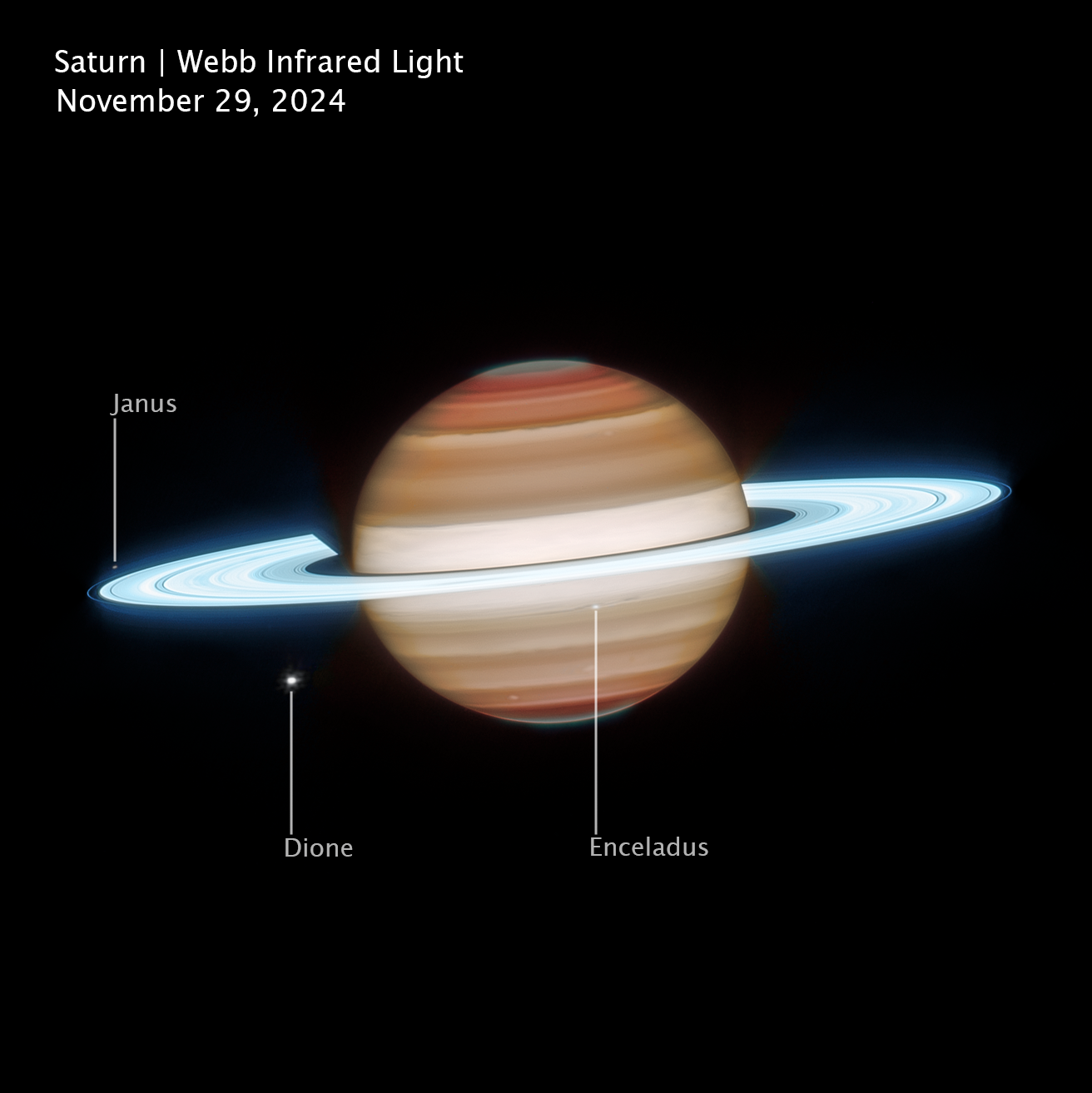
Webb Telescope Reveals Saturn's Rings in Infrared
The Gist
James Webb Space Telescope captures Saturn's icy rings glowing brightly in infrared, offering new insights into its atmosphere.
Explain Like I'm Five
"Imagine Saturn's rings are made of shiny ice. The Webb telescope sees them glowing super bright because of this ice, like a disco ball reflecting light. The telescope also sees weird colors at Saturn's top and bottom, which might be from special air or space weather."
Deep Intelligence Analysis
Transparency: This analysis is based solely on the provided source text. No external information was used. The AI model (Gemini 2.5 Flash) was used to generate the analysis and JSON output. The analysis aims to provide an objective summary and interpretation of the source material.
_Context: This intelligence report was compiled by the DailyOrbitalWire Strategy Engine. Verified for Art. 50 Compliance._
Impact Assessment
The infrared image provides a more detailed understanding of Saturn's atmosphere, complementing Hubble's observations. Analyzing the light wavelengths helps scientists understand the composition and dynamics of the planet's rings and atmosphere.
Read Full Story on NASA Breaking NewsKey Details
- ● Image released March 25, 2026.
- ● Saturn's rings appear bright in infrared due to reflective water ice.
- ● Saturn's poles appear grey-green, indicating light emission around 4.3 microns.
Optimistic Outlook
Advanced telescopes like Webb are enhancing our understanding of planetary systems, potentially leading to breakthroughs in atmospheric science and planetary formation theories. Further analysis of Saturn's atmosphere could reveal new insights into gas giant dynamics and ring composition.
Pessimistic Outlook
The interpretation of the grey-green poles is currently speculative, requiring further research to confirm the presence of high-altitude aerosols or auroral activity. Relying on single data points from specific wavelengths may lead to incomplete or biased conclusions about Saturn's atmospheric processes.

The Signal, Not
the Noise|
Get the week's top 1% of space-tech intelligence synthesized into a 5-minute read. Join 25,000+ aerospace insiders.
Unsubscribe anytime. No spam, ever.