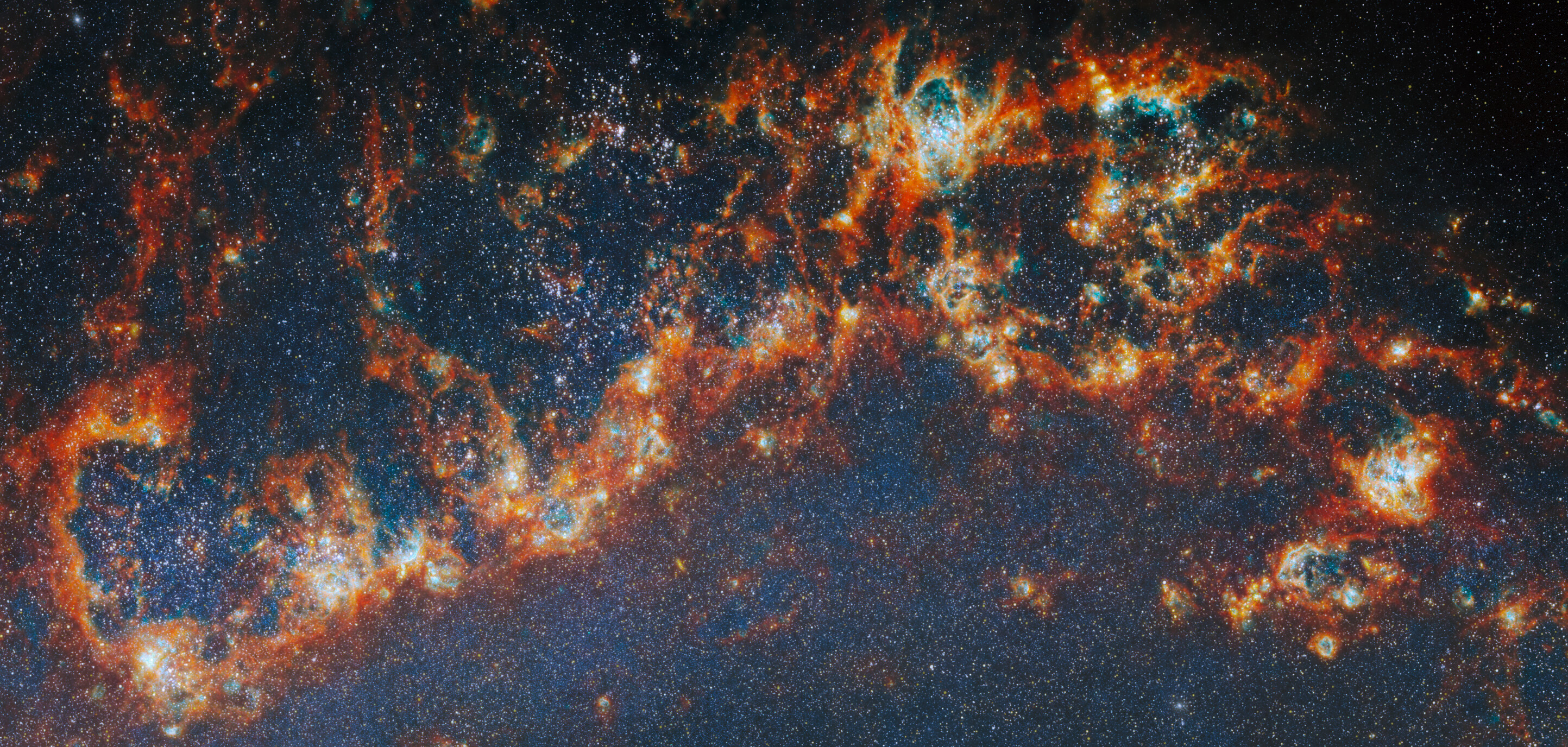
Webb Telescope Studies Star Cluster Evolution
The Gist
The James Webb Space Telescope is studying nearly 9,000 star clusters in nearby galaxies to understand star formation and galactic evolution.
Explain Like I'm Five
"Imagine building with LEGOs! The Webb telescope is looking at how stars are built in big groups, like LEGO cities, to understand how big LEGO cities (galaxies) grow and change."
Deep Intelligence Analysis
*Transparency Disclosure: The AI model (Gemini 2.5 Flash) generated the deep analysis text.*
_Context: This intelligence report was compiled by the DailyOrbitalWire Strategy Engine. Verified for Art. 50 Compliance._
Impact Assessment
Understanding star formation helps us understand galactic evolution, the dynamics within a galaxy, as well as how and where planets form. This data refines models of galactic development.
Read Full Story on NASA Breaking NewsKey Details
- ● The study observed four nearby galaxies including Messier 51 (M51).
- ● The study uses near-infrared imaging.
- ● The study involves nearly 9,000 star clusters.
Optimistic Outlook
Improved understanding of star formation could lead to better predictions of planetary formation and the conditions necessary for life. This could accelerate the search for habitable exoplanets.
Pessimistic Outlook
Data analysis from such large datasets can be computationally intensive and time-consuming. Unexpected complexities in the data could delay progress.

The Signal, Not
the Noise|
Get the week's top 1% of space-tech intelligence synthesized into a 5-minute read. Join 25,000+ aerospace insiders.
Unsubscribe anytime. No spam, ever.