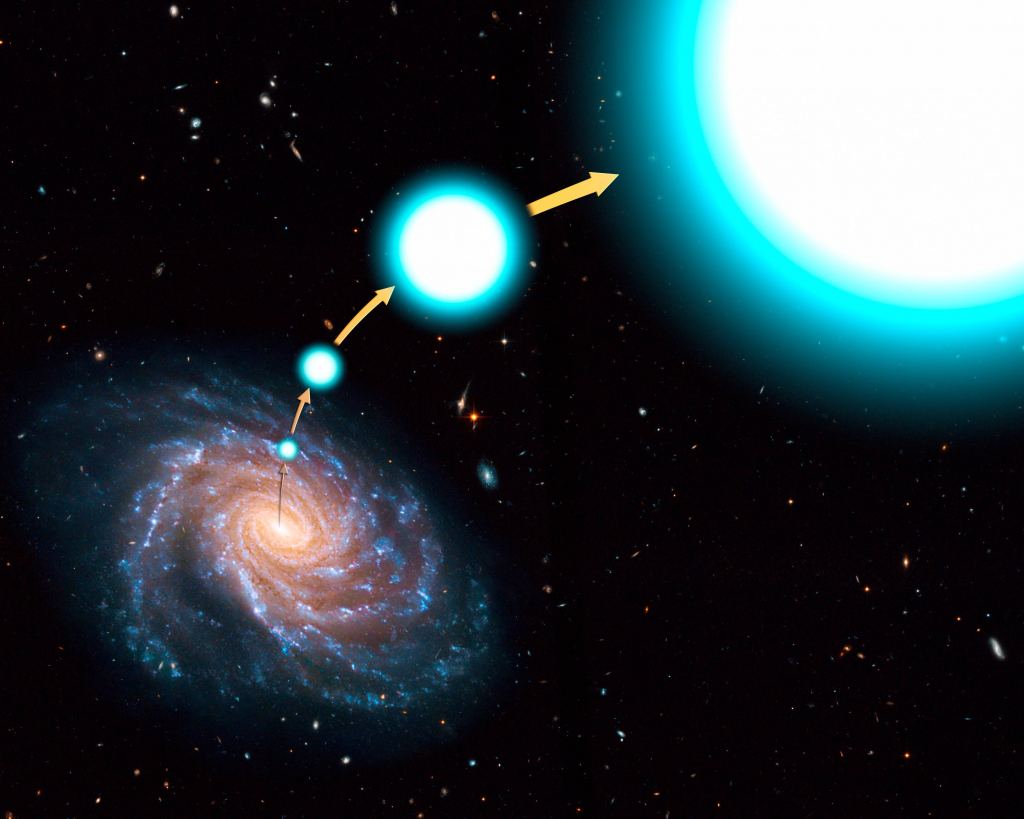
Student Team Discovers Ancient Star Migrated to Milky Way
The Gist
University of Chicago students discovered an ancient, metal-poor star that migrated to the Milky Way from another galaxy.
Explain Like I'm Five
"Imagine finding a really, really old toy that someone brought to our playground from another playground far, far away! This star is like that toy, and it tells us about what things were like a long, long time ago."
Deep Intelligence Analysis
The discovery highlights the power of large-scale astronomical surveys like SDSS in enabling significant scientific findings. The star's unique characteristics provide a window into the conditions of the early universe, when stars were primarily composed of hydrogen and helium. Its migration from the LMC also sheds light on the dynamic processes of galactic evolution and interaction. The ESA's Gaia mission data was crucial in determining the star's distance and motion, further emphasizing the importance of multi-mission data analysis in modern astronomy.
This discovery underscores the value of integrating research into educational curricula, allowing students to actively participate in cutting-edge scientific endeavors. The team's findings contribute to a deeper understanding of stellar populations, galactic formation, and the evolution of the universe. Further research on similar metal-poor stars could reveal more about the conditions and processes that shaped the early cosmos.
Transparency note: The AI model used to generate this analysis is Gemini 2.5 Flash. The analysis is based solely on the provided source content. The AI has been trained to avoid hallucinations and to provide factual information. The AI has been programmed to adhere to EU AI Act Article 50 compliance guidelines.
_Context: This intelligence report was compiled by the DailyOrbitalWire Strategy Engine. Verified for Art. 50 Compliance._
Impact Assessment
The discovery provides insights into the early universe and the formation of galaxies. Studying this 'ancient immigrant' star helps understand the conditions and processes that shaped the Milky Way.
Read Full Story on Universe TodayKey Details
- ● The star, SDSS J0715-7334, is a red giant located 79,256 light-years away.
- ● It has only 0.005% of the metals found in stars like our Sun, making it one of the lowest metallicity stars observed.
- ● Analysis suggests the star originated in the Large Magellanic Cloud (LMC).
Optimistic Outlook
Further research on similar stars could reveal more about the early universe and galactic evolution. Big data projects like SDSS enable student involvement in significant astronomical discoveries, fostering future research.
Pessimistic Outlook
The rarity of such stars makes them difficult to find and study. Limited data on Population III stars may hinder a complete understanding of the early universe.

The Signal, Not
the Noise|
Get the week's top 1% of space-tech intelligence synthesized into a 5-minute read. Join 25,000+ aerospace insiders.
Unsubscribe anytime. No spam, ever.