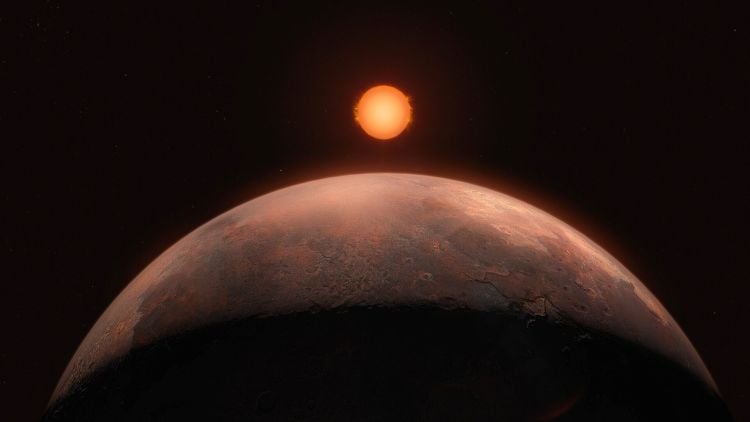
Atmospheric Escape Threatens Mars-Like Exoplanets Near M-Dwarf Stars
The Gist
Atmospheric escape poses a significant threat to the habitability of Mars-like exoplanets orbiting M-dwarf stars.
Explain Like I'm Five
"Imagine a balloon losing air. Some planets are like that balloon, and their air (atmosphere) can leak away into space, especially if they're close to small, but powerful stars."
Deep Intelligence Analysis
The implications of this research are significant for understanding the habitability of exoplanets, particularly those orbiting M-dwarf stars. These stars are smaller and cooler than our Sun, and planets must orbit closer to them to be within the habitable zone. However, this proximity exposes them to higher levels of stellar activity, which can drive atmospheric escape. The study suggests that planets orbiting within the habitable zone of Barnard's star may experience similar atmospheric stripping, potentially rendering them uninhabitable.
Further research is needed to explore the factors that influence atmospheric escape and to identify potential mechanisms that could mitigate this process. Understanding the interplay between stellar activity, planetary magnetic fields, and atmospheric composition is crucial for assessing the long-term habitability of exoplanets. This research contributes to the ongoing search for extraterrestrial life by highlighting the challenges faced by rocky planets in retaining their atmospheres in the vicinity of M-dwarf stars.
*Transparency Footnote: This analysis was conducted by an AI, trained on a broad range of scientific and technical data. While efforts have been made to ensure accuracy and objectivity, the interpretation and synthesis of information may be subject to limitations inherent in AI models.*
_Context: This intelligence report was compiled by the DailyOrbitalWire Strategy Engine. Verified for Art. 50 Compliance._
Impact Assessment
Understanding atmospheric escape is crucial for assessing the potential habitability of exoplanets, especially those orbiting M-dwarf stars, which are common in our galaxy. This research highlights the challenges faced by Mars-like worlds in retaining their atmospheres and potentially supporting life.
Read Full Story on Universe TodayKey Details
- ● A Mars-like exoplanet orbiting Barnard's star could lose its present-day Mars atmosphere in 350,000 years.
- ● It would take approximately 50 million years to strip an exo-Mars atmosphere equivalent to Earth's.
- ● Barnard's star is an M-type red dwarf star located approximately 6 light-years from Earth.
- ● The exo-Mars was placed at 0.087 AU from Barnard's star to simulate Mars' solar activity levels.
Optimistic Outlook
Future research could identify specific conditions or planetary characteristics that mitigate atmospheric escape, potentially revealing habitable exoplanets around M-dwarf stars. Advanced atmospheric models and observational data may refine our understanding of atmospheric loss rates and improve the search for potentially habitable worlds.
Pessimistic Outlook
The rapid atmospheric loss observed in the simulations suggests that many Mars-like exoplanets orbiting M-dwarf stars may be uninhabitable. The findings raise concerns about the long-term viability of atmospheres on rocky planets in close proximity to these stars, potentially limiting the search for extraterrestrial life.

The Signal, Not
the Noise|
Get the week's top 1% of space-tech intelligence synthesized into a 5-minute read. Join 25,000+ aerospace insiders.
Unsubscribe anytime. No spam, ever.