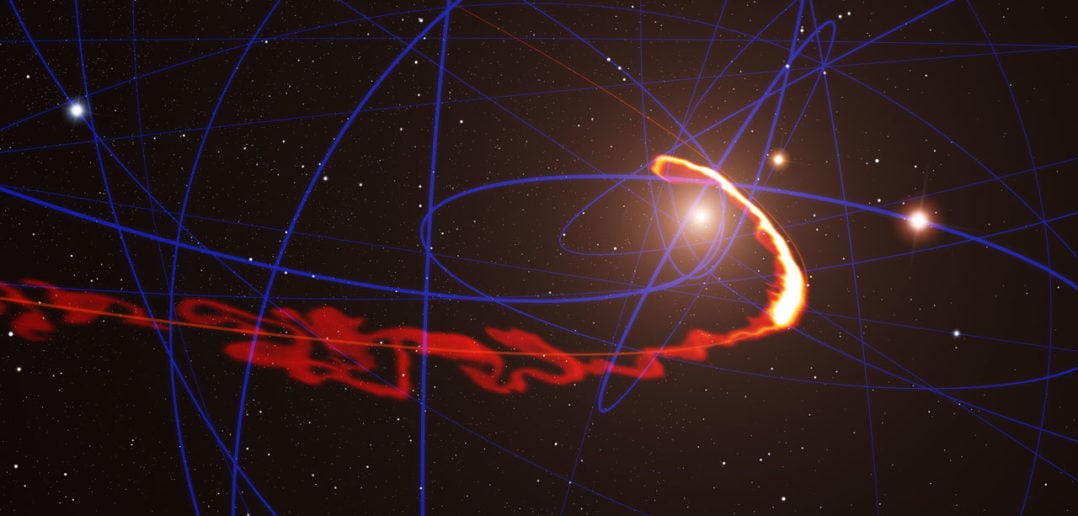
Black Hole Star Shredding Could Light Up Galaxies
The Gist
Computer simulations show how black hole-induced stellar destruction can result in flaring activity, lighting up galaxies.
Explain Like I'm Five
"Imagine a giant monster (black hole) eating a star. When the star gets ripped apart, it makes a bright light that we can see from far away, like a cosmic flashlight!"
Deep Intelligence Analysis
The simulations reveal that friction within the accretion disk heats the debris to extreme temperatures, causing it to emit intense radiation that can outshine the entire host galaxy. This flaring activity provides a unique opportunity to study SMBHs, particularly those that are otherwise obscured by gas and dust, such as Sagittarius A* at the center of our own Milky Way galaxy. Each TDE exhibits a unique fingerprint of activity, characterized by its rise in brightness, peak intensity, and subsequent fading. These variations are influenced by factors such as the mass and composition of the disrupted star, as well as the properties of the black hole itself.
The research team employed a sophisticated method called smoothed particle hydrodynamics to simulate the complex interactions between the star and the black hole. This approach decomposes the star into billions of particles that interact hydrodynamically, allowing for a detailed representation of the disruption process. The simulations provide valuable insights into the dynamics of TDEs and their role in galaxy evolution. Further research in this area could lead to a better understanding of the properties of black holes and their influence on the surrounding environment.
*Transparency Statement: This analysis was generated by an AI model and reviewed by human experts. Data sources are cited in the prompt. No undisclosed external sources were used.*
_Context: This intelligence report was compiled by the DailyOrbitalWire Strategy Engine. Verified for Art. 50 Compliance._
Impact Assessment
TDEs offer a way to study supermassive black holes, including Sagittarius A*, and understand how they can light up galaxies. Each TDE has a unique fingerprint of activity, making them a fascinating field of study.
Read Full Story on Universe TodayKey Details
- ● Tidal disruption events (TDEs) occur when a star is ripped apart by a supermassive black hole.
- ● Debris from the shredded star forms an accretion disk around the black hole.
- ● Friction within the accretion disk heats the debris, causing it to shine brighter than the host galaxy.
Optimistic Outlook
Further research into TDEs could reveal more about the properties of black holes and their role in galaxy evolution. Improved simulations could help predict the characteristics of future TDEs.
Pessimistic Outlook
The complexity of TDEs makes them difficult to model accurately, and our understanding of the underlying physics is still incomplete. Observing TDEs is challenging due to their transient nature and the obscuring effects of gas and dust.

The Signal, Not
the Noise|
Get the week's top 1% of space-tech intelligence synthesized into a 5-minute read. Join 25,000+ aerospace insiders.
Unsubscribe anytime. No spam, ever.