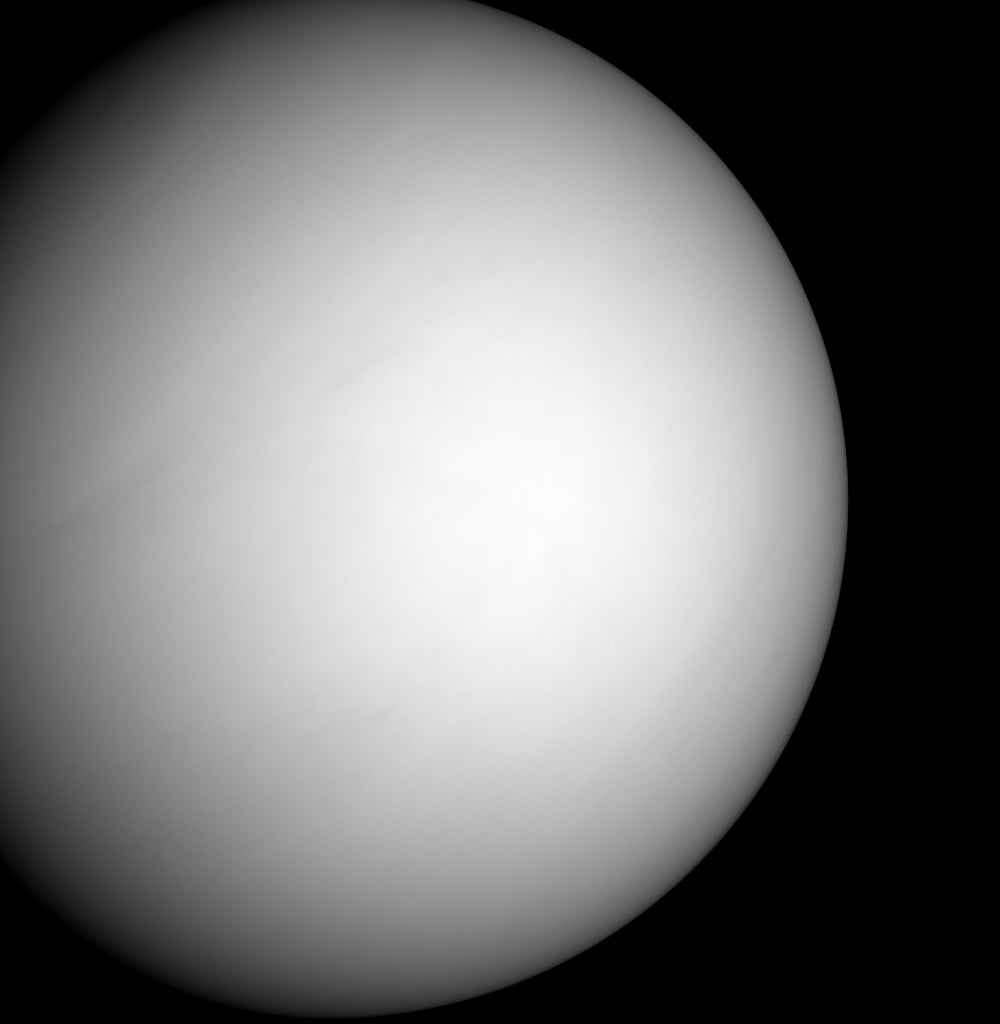
Cosmic Dust Identified as Source of Venus' Lower Haze
The Gist
Cosmic dust from meteors burning up in Venus' atmosphere is identified as the source of the planet's mysterious lower haze.
Explain Like I'm Five
"Imagine tiny bits of space rocks falling on Venus. These bits help make the clouds and change the weather there!"
Deep Intelligence Analysis
_Context: This intelligence report was compiled by the DailyOrbitalWire Strategy Engine. Verified for Art. 50 Compliance._
Impact Assessment
Understanding the composition and processes within Venus' atmosphere provides insights into planetary weather and climate. The discovery highlights the active role of space material in shaping planetary environments, potentially applicable to other planets.
Read Full Story on Universe TodayKey Details
- ● Cosmic dust particles from meteors act as seeds for cloud formation on Venus, boosting cloud production by 20-30%.
- ● The metallic content of the dust, particularly iron, may explain the 'unknown UV absorber' in Venus' atmosphere.
- ● NASA's DAVINCI mission, planned for the late 2020s, will directly sample Venus' atmosphere to test these predictions.
Optimistic Outlook
The DAVINCI mission will provide direct atmospheric samples, potentially validating the cosmic dust theory and refining climate models. This could lead to a better understanding of atmospheric processes on other planets, including Earth.
Pessimistic Outlook
The complexity of Venus' atmosphere and the challenges of in-situ measurements could delay full validation of the cosmic dust theory. The 'unknown UV absorber' may have other contributing factors beyond iron-rich dust.

The Signal, Not
the Noise|
Get the week's top 1% of space-tech intelligence synthesized into a 5-minute read. Join 25,000+ aerospace insiders.
Unsubscribe anytime. No spam, ever.