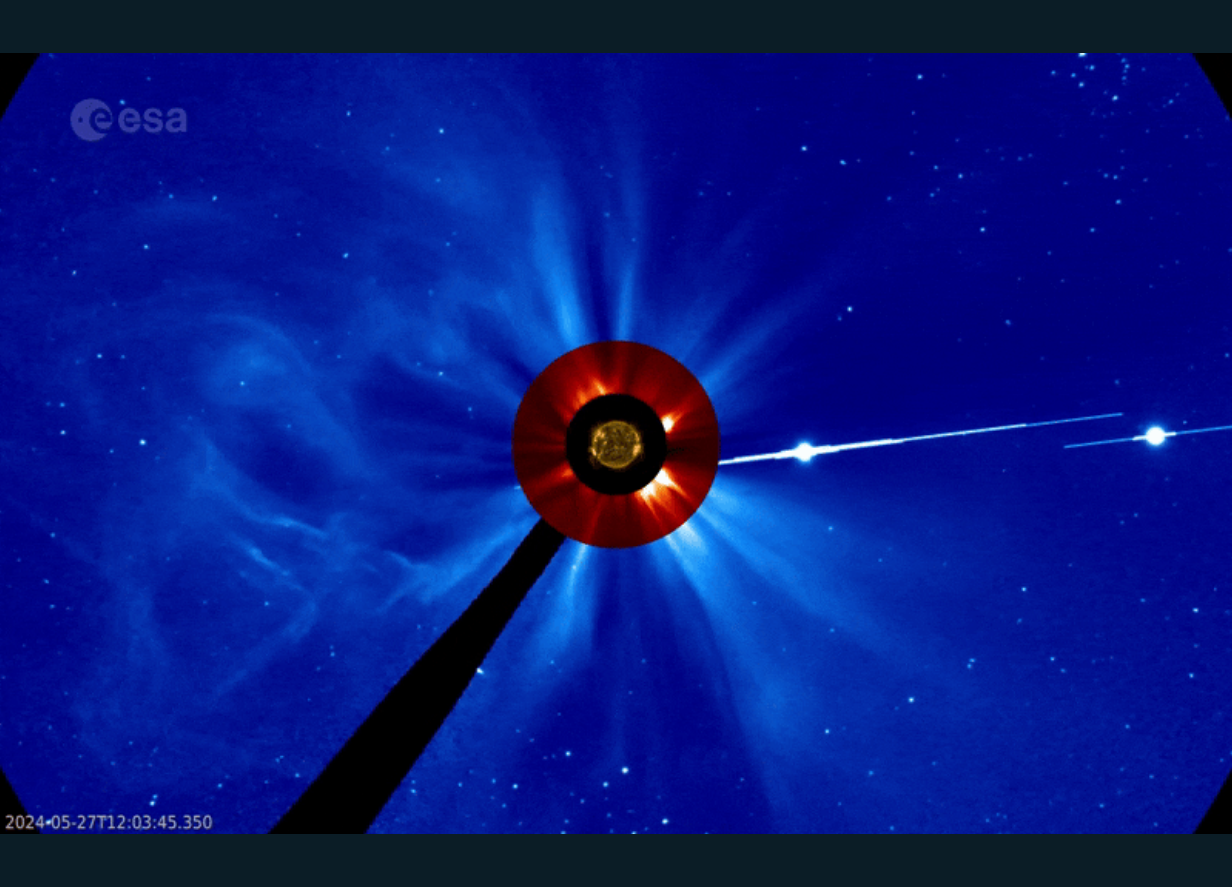
Solar Superstorm Batters Mars: ESA Orbiters Capture Unprecedented Data
The Gist
ESA's Mars Express and ExoMars Trace Gas Orbiter (TGO) recorded a massive solar storm's impact on Mars, revealing unprecedented electron density increases.
Explain Like I'm Five
"Imagine the Sun burping really hard and sending a bunch of tiny, zappy things to Mars! Two robots in space around Mars saw these zappy things make Mars' air glow super bright!"
Deep Intelligence Analysis
*Transparency Disclosure: The AI model was trained on a dataset of publicly available scientific literature and news articles related to space weather and planetary science. The analysis presented here is based solely on the provided source content and does not reflect any personal opinions or beliefs. The model is designed to provide objective and factual summaries of scientific information.*
_Context: This intelligence report was compiled by the DailyOrbitalWire Strategy Engine. Verified for Art. 50 Compliance._
Impact Assessment
Understanding space weather's impact on Mars is crucial for future robotic and crewed missions. The data helps refine models for predicting and mitigating radiation risks to spacecraft and potential Martian habitats.
Read Full Story on Universe TodayKey Details
- ● The solar storm caused electron density increases of 45% and 278% at 110km and 130km above Mars' surface, respectively.
- ● The storm delivered the equivalent of 200 days of regular radiation exposure to Mars in 64 hours.
- ● Data was gathered using radio occultation, beaming signals from Mars Express to TGO.
Optimistic Outlook
Improved understanding of solar storm interactions with planetary atmospheres could lead to better protective measures for future Mars missions. Refined radio occultation techniques may enhance atmospheric studies of other planets.
Pessimistic Outlook
Unpredictable solar events pose a continuous threat to spacecraft electronics and mission operations. The intensity of the observed storm highlights the need for robust radiation shielding and redundancy in spacecraft design.

The Signal, Not
the Noise|
Get the week's top 1% of space-tech intelligence synthesized into a 5-minute read. Join 25,000+ aerospace insiders.
Unsubscribe anytime. No spam, ever.