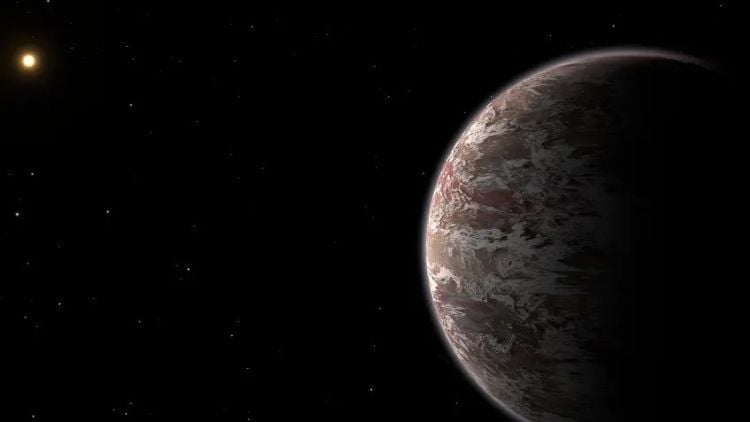
JWST Detects Water-Ice Clouds on Super-Jupiter Exoplanet Eps Ind Ab
The Gist
JWST discovers water-ice clouds in the atmosphere of the super-Jupiter exoplanet Eps Ind Ab, challenging existing atmospheric models.
Explain Like I'm Five
"Imagine Jupiter, but bigger and farther away. Scientists using a super telescope found icy clouds there! This means our old ideas about planets might need to be updated."
Deep Intelligence Analysis
The implications of this finding extend to our understanding of planetary formation and evolution. The presence of water-ice clouds suggests that the atmospheric processes on Eps Ind Ab are more complex than previously anticipated. This complexity necessitates a re-evaluation of current models and could lead to new insights into the mechanisms that govern exoplanet atmospheres. Furthermore, the ability of JWST to detect these clouds demonstrates its powerful capabilities for characterizing exoplanets and opens doors for future studies of other distant worlds.
From a market perspective, this discovery underscores the importance of continued investment in space-based observatories like JWST. These telescopes provide invaluable data that drives scientific advancements and enhances our understanding of the universe. The demand for advanced instrumentation and data analysis tools will likely increase as we continue to explore exoplanets and search for habitable worlds. This creates opportunities for companies specializing in space technology, data science, and scientific research.
_Context: This intelligence report was compiled by the DailyOrbitalWire Strategy Engine. Verified for Art. 50 Compliance._
Impact Assessment
The discovery of water-ice clouds challenges existing planetary atmosphere models that often omit clouds for simplicity. This finding necessitates re-evaluation of these models, potentially leading to a more accurate understanding of exoplanet atmospheres.
Read Full Story on Universe TodayKey Details
- ● Eps Ind Ab is approximately 12 light-years from Earth and 7.6 times the mass of Jupiter.
- ● The exoplanet's temperature is estimated at 275 Kelvin (2 degrees Celsius/35 degrees Fahrenheit).
- ● Researchers found lower than anticipated ammonia levels, attributing extra brightness to water-ice clouds.
- ● Eps Ind Ab orbits its star at approximately 30 astronomical units (AU).
Optimistic Outlook
JWST's capabilities are enabling detailed characterization of exoplanet atmospheres, including cloud detection. This opens doors for more in-depth studies of cold, distant worlds, potentially revealing new layers of complexity in planetary formation and evolution.
Pessimistic Outlook
Current atmospheric models may be inadequate for accurately simulating exoplanet atmospheres, potentially hindering our understanding of their composition and evolution. The complexity of incorporating cloud formations into these models presents a significant computational challenge.

The Signal, Not
the Noise|
Get the week's top 1% of space-tech intelligence synthesized into a 5-minute read. Join 25,000+ aerospace insiders.
Unsubscribe anytime. No spam, ever.