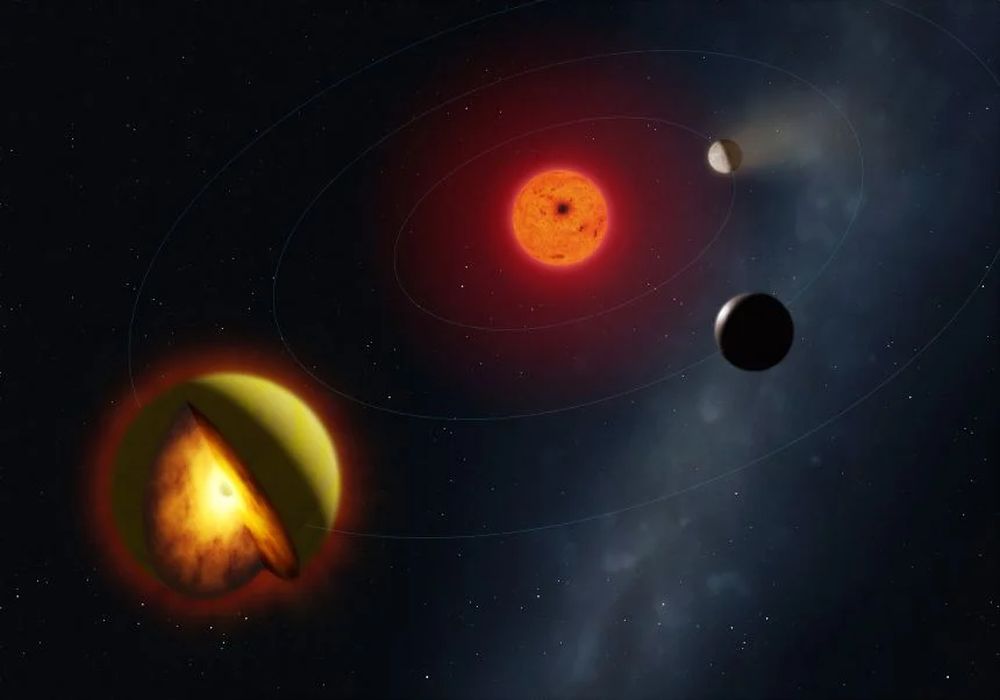
Exoplanet L 98-59 d: A 5-Billion-Year-Old Magma Ocean World
The Gist
New research suggests exoplanet L 98-59 d is a new class of planet with a long-lasting magma ocean due to high sulphur content.
Explain Like I'm Five
"Imagine a planet that's mostly melted rock inside, like a giant lava lamp, and it stays that way for billions of years because it has a special ingredient called sulphur!"
Deep Intelligence Analysis
Researchers modeled 5 billion years of the planet's history and found that it possesses a vast magma ocean extending thousands of kilometers below the mantle. The presence of sulphur in this magma ocean lowers the melting point, allowing it to remain molten for an extended period. The planet also has a thick atmosphere rich in hydrogen and sulphur-bearing gases like hydrogen sulphide (H2S). The persistence of H2S, despite being prone to stripping by the host star, further underscores the unique characteristics of this exoplanet.
From an astrobiological perspective, the discovery of L 98-59 d raises questions about the potential for habitability on planets with similar characteristics. While the extreme conditions on L 98-59 d itself make it unlikely to harbor life, studying its formation and evolution could provide insights into the conditions necessary for life to arise on other exoplanets. The research also highlights the importance of considering a wider range of planetary compositions and internal structures when assessing exoplanet habitability.
_Context: This intelligence report was compiled by the DailyOrbitalWire Strategy Engine. Verified for Art. 50 Compliance._
Impact Assessment
The discovery of this new class of exoplanet challenges existing models of planetary formation and evolution. Understanding the role of sulphur in maintaining magma oceans could provide insights into planetary habitability.
Read Full Story on Universe TodayKey Details
- ● L 98-59 d has a density of 2.2 g cm−3, about 40% of Earth's.
- ● The planet orbits an M-dwarf star 35 light-years away.
- ● It has 1.64 Earth masses and 1.627 Earth radii.
- ● L 98-59 d's magma ocean contains a significant amount of sulphur.
- ● The planet has a thick hydrogen-rich atmosphere with sulphur-bearing gases.
Optimistic Outlook
Further research on L 98-59 d could reveal new details about the conditions necessary for life to arise on other planets. This could refine the search for habitable exoplanets and increase the chances of finding extraterrestrial life.
Pessimistic Outlook
The extreme conditions on L 98-59 d, such as the presence of a magma ocean and a thick, sulphur-rich atmosphere, make it unlikely to be habitable. The planet's proximity to a red dwarf star also exposes it to high levels of radiation.

The Signal, Not
the Noise|
Get the week's top 1% of space-tech intelligence synthesized into a 5-minute read. Join 25,000+ aerospace insiders.
Unsubscribe anytime. No spam, ever.