BREAKING: Awaiting the latest intelligence wire...
Back to Wire
Four-Legged Rovers with Limited Instruments for Planetary Exploration
Habitats & ISRU

Four-Legged Rovers with Limited Instruments for Planetary Exploration

Source: Universe Today Original Author: Evan Gough Intelligence Analysis by Gemini

The Gist

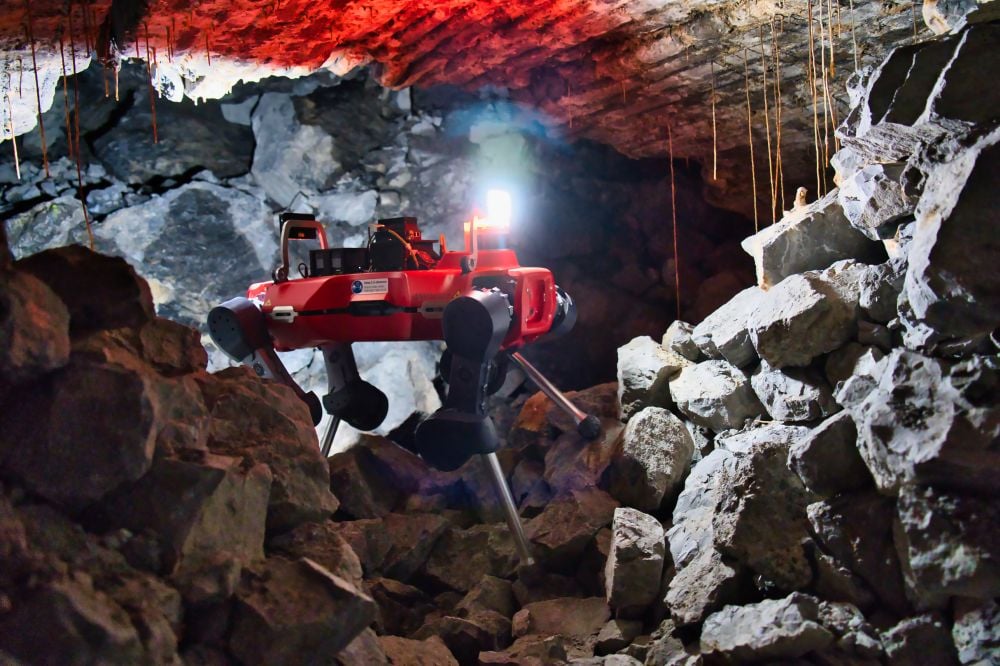
Research suggests that smaller, semi-autonomous, four-legged rovers carrying only two instruments could efficiently explore Mars and the Moon.

Explain Like I'm Five

"Imagine a robot dog exploring Mars all by itself, using a magnifying glass and a special light to find cool rocks!"

Deep Intelligence Analysis

The research highlights a shift towards smaller, more agile, and semi-autonomous rovers for planetary exploration. These four-legged robots, exemplified by the ANYmal platform, offer advantages over traditional rovers in terms of mobility and operational efficiency. The ability to navigate uneven terrain and perform limited climbing actions allows them to access areas that are inaccessible to wheeled rovers. The integration of a microscopic imager (MICRO) and a Raman spectrometer (MIRA XTR) on a robotic arm provides a powerful tool for in-situ characterization of sample morphologies and mineralogies. The semi-autonomous nature of these rovers addresses the challenges posed by communication delays between Earth and Mars, enabling them to make decisions and explore multiple targets without constant human supervision. The study emphasizes the importance of the MICRO and Raman spectrometer combination for both scientific research into astrobiology and the practical need to prospect for water ice and other materials on the Moon and Mars. This reflects the growing interest in in-situ resource utilization (ISRU) for future space missions. The testing of these rovers in Martian and Lunar analogue missions demonstrates their potential for real-world applications. The comparison of semi-autonomous operation with conventional human-supervised exploration highlights the benefits of increased autonomy in terms of efficiency and scientific output. The development of these advanced robotic systems could significantly enhance our ability to explore and understand the surfaces of other planets.

_Context: This intelligence report was compiled by the DailyOrbitalWire Strategy Engine. Verified for Art. 50 Compliance._

Impact Assessment

Semi-autonomous rovers can overcome communication delays, enabling faster and more efficient surface prospecting. The combination of a microscopic imager and Raman spectrometer is effective for identifying Martian and Lunar analogue samples.

Read Full Story on Universe Today

Key Details

  • Researchers tested a four-legged robot (ANYmal) with a microscopic imager and Raman spectrometer.
  • The robot's semi-autonomous operation allows it to study multiple targets without detailed human instructions.
  • The average time for a return radio communication with Mars is about 25 minutes.

Optimistic Outlook

These rovers could accelerate the search for water ice and other resources on Mars and the Moon. Their agility and autonomy could unlock new areas for exploration.

Pessimistic Outlook

The limited instrument payload may restrict the scope of scientific investigations. The reliance on semi-autonomy could lead to unforeseen challenges in complex terrains.

DailyOrbitalWire Logo

The Signal, Not
the Noise|

Get the week's top 1% of space-tech intelligence synthesized into a 5-minute read. Join 25,000+ aerospace insiders.

Unsubscribe anytime. No spam, ever.

```