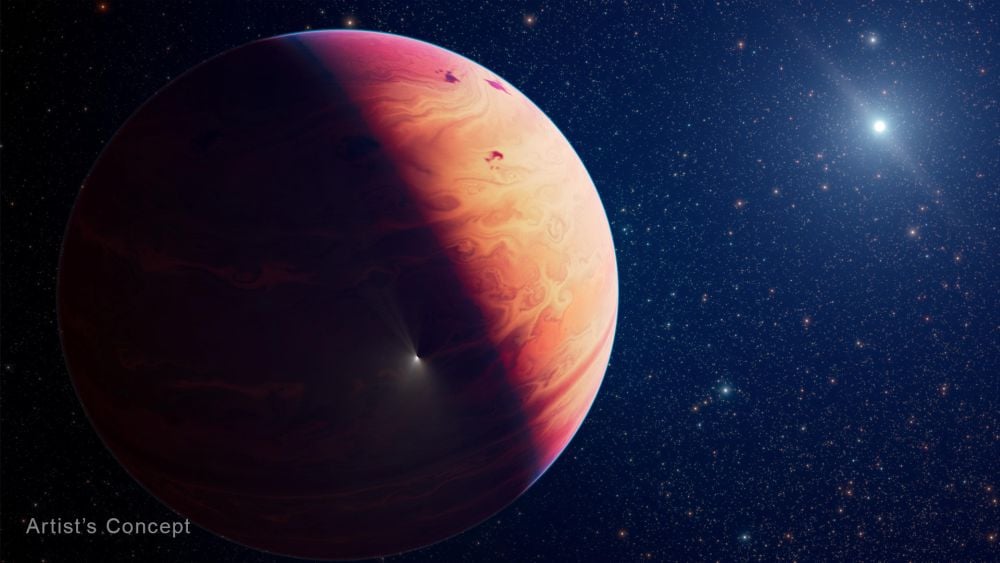
JWST Images Object Challenging Star-Planet Boundary
The Gist
JWST directly imaged 29 Cygni b, an object blurring the lines between planet and star.
Explain Like I'm Five
"Imagine a big ball in space that's too big to be a planet but not quite a star. JWST, a super-powerful telescope, took a picture of it and found out what it's made of, helping us understand how planets and stars are born."
Deep Intelligence Analysis
The deuterium burning limit, often used to differentiate between brown dwarfs and planets, is central to this discussion. Brown dwarfs, sometimes referred to as "failed stars," can fuse deuterium but not hydrogen. 29 Cygni b's mass falls within this limit, further complicating its classification. The research, published in The Astrophysical Journal Letters, emphasizes the significance of direct imaging and atmospheric analysis in unraveling the mysteries of exoplanetary systems. JWST's capabilities allow scientists to probe the composition and formation history of objects that blur the lines between planets and stars, paving the way for a more comprehensive understanding of the cosmos.
Ultimately, the study of objects like 29 Cygni b will refine our understanding of planetary and stellar formation processes. Future observations and analysis will likely reveal more about the conditions under which these objects form, potentially leading to new classification schemes and a deeper appreciation of the diversity of celestial bodies in the universe. This research highlights the transformative potential of JWST in advancing our knowledge of exoplanets and the broader universe.
*Transparency: This analysis was generated by an AI model and reviewed by human experts. Data is sourced from the provided article.*
_Context: This intelligence report was compiled by the DailyOrbitalWire Strategy Engine. Verified for Art. 50 Compliance._
Impact Assessment
The discovery challenges existing definitions of planets and stars, particularly regarding formation processes. JWST's capabilities allow for direct imaging and atmospheric analysis of such boundary objects, enhancing our understanding of exoplanetary systems.
Read Full Story on Universe TodayKey Details
- ● 29 Cygni b is 15 times the mass of Jupiter.
- ● It orbits an A-type main sequence star at 2.4 billion km.
- ● JWST detected carbon monoxide and carbon dioxide in its atmosphere.
- ● The object's mass is near the deuterium burning limit (15 ± 5 Jupiter masses).
Optimistic Outlook
JWST's ability to analyze the composition of objects like 29 Cygni b will refine our understanding of planetary formation. Future observations could reveal more about the conditions under which planets and stars form, potentially leading to new classifications.
Pessimistic Outlook
The ambiguity surrounding the classification of objects like 29 Cygni b highlights the limitations of current models. Further research is needed to fully understand the formation processes and atmospheric characteristics of these objects.

The Signal, Not
the Noise|
Get the week's top 1% of space-tech intelligence synthesized into a 5-minute read. Join 25,000+ aerospace insiders.
Unsubscribe anytime. No spam, ever.