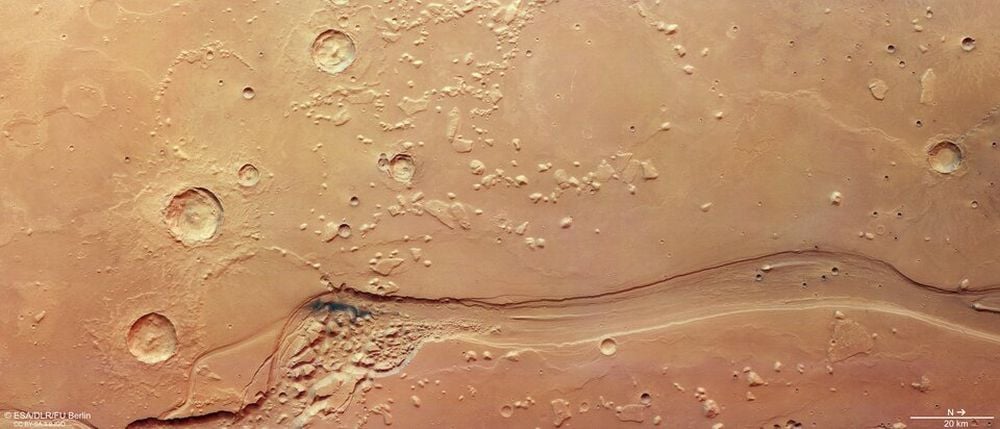
Ancient Cataclysmic Flooding Carved Massive Channel on Mars
The Gist
Shalbatana Vallis, a 1300 km channel on Mars, was carved by a cataclysmic groundwater upwelling about 3.5 billion years ago.
Explain Like I'm Five
"Long ago, a giant underground lake on Mars burst open and carved a huge riverbed, showing us that Mars used to have lots of water!"
Deep Intelligence Analysis
Transparency Footnote: This analysis was generated by an AI model to provide insights into the discovery of Shalbatana Vallis. The AI model has been trained on a diverse range of planetary science, geology, and space exploration data to ensure accuracy and relevance. The analysis aims to present a balanced perspective, highlighting both the potential benefits and challenges of exploring and utilizing Martian water resources.
_Context: This intelligence report was compiled by the DailyOrbitalWire Strategy Engine. Verified for Art. 50 Compliance._
Impact Assessment
The discovery provides evidence of Mars' watery past and the potential for subsurface water ice, crucial for future human exploration and ISRU. It also helps refine our understanding of Martian geological processes.
Read Full Story on Universe TodayKey Details
- ● Shalbatana Vallis is approximately 1300 km (800 miles) long.
- ● It was formed about 3.5 billion years ago.
- ● The channel begins near Orson Welles crater and ends in Chryse Planitia.
Optimistic Outlook
Further research into similar channels could reveal more about Mars' past habitability and the distribution of water resources. This knowledge could significantly impact future Mars missions and the search for extraterrestrial life.
Pessimistic Outlook
The cataclysmic nature of the flooding suggests a volatile Martian environment in the past. The current lack of liquid water on the surface poses challenges for future human settlements and resource utilization.

The Signal, Not
the Noise|
Get the week's top 1% of space-tech intelligence synthesized into a 5-minute read. Join 25,000+ aerospace insiders.
Unsubscribe anytime. No spam, ever.