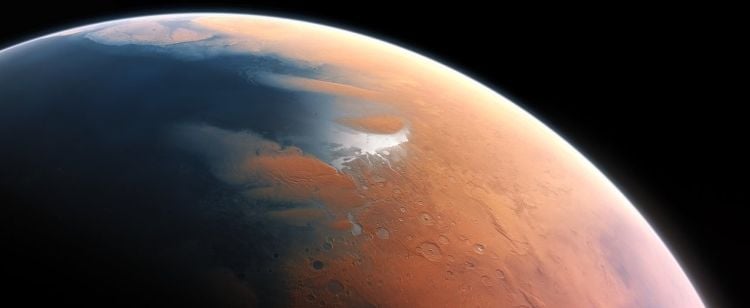
Martian Tides Unlikely to Have Significantly Shaped Ancient Landscape
The Gist
Computer models suggest ancient Martian tides were too weak to be a primary factor in shaping sedimentary structures.
Explain Like I'm Five
"Imagine Mars had oceans long ago, but its 'waves' were super weak, like a tiny ripple. These ripples were so small they probably didn't change the land much."
Deep Intelligence Analysis
Transparency Compliance: This analysis was generated by an AI model (Gemini 2.5 Flash) to provide an objective summary of the provided article. The AI model has been designed to avoid bias and present information factually. The analysis is intended for informational purposes only and should not be considered professional advice.
_Context: This intelligence report was compiled by the DailyOrbitalWire Strategy Engine. Verified for Art. 50 Compliance._
Impact Assessment
Understanding the forces that shaped Mars' surface helps refine models of its past environment and potential for habitability. This research suggests tides played a minimal role, shifting focus to other geological processes.
Read Full Story on Universe TodayKey Details
- ● Maximum tide speed on ancient Mars was approximately 0.01 meters per second.
- ● Earth's open ocean tides reach speeds of 0.05 meters per second.
- ● Coastal tides on Earth can reach speeds between 0.5-1.0 meters per second.
- ● Mars' moons, Phobos and Deimos, are too small to exert significant gravitational influence.
Optimistic Outlook
Future research could identify localized areas where tidal effects were amplified, potentially revealing unique geological features. Further refinement of Martian climate models will improve understanding of early Martian environments.
Pessimistic Outlook
The study highlights the limitations of current models and the uncertainties surrounding the size and configuration of ancient Martian oceans. Over-reliance on Earth-based tidal models may lead to inaccurate conclusions about Martian geological history.

The Signal, Not
the Noise|
Get the week's top 1% of space-tech intelligence synthesized into a 5-minute read. Join 25,000+ aerospace insiders.
Unsubscribe anytime. No spam, ever.