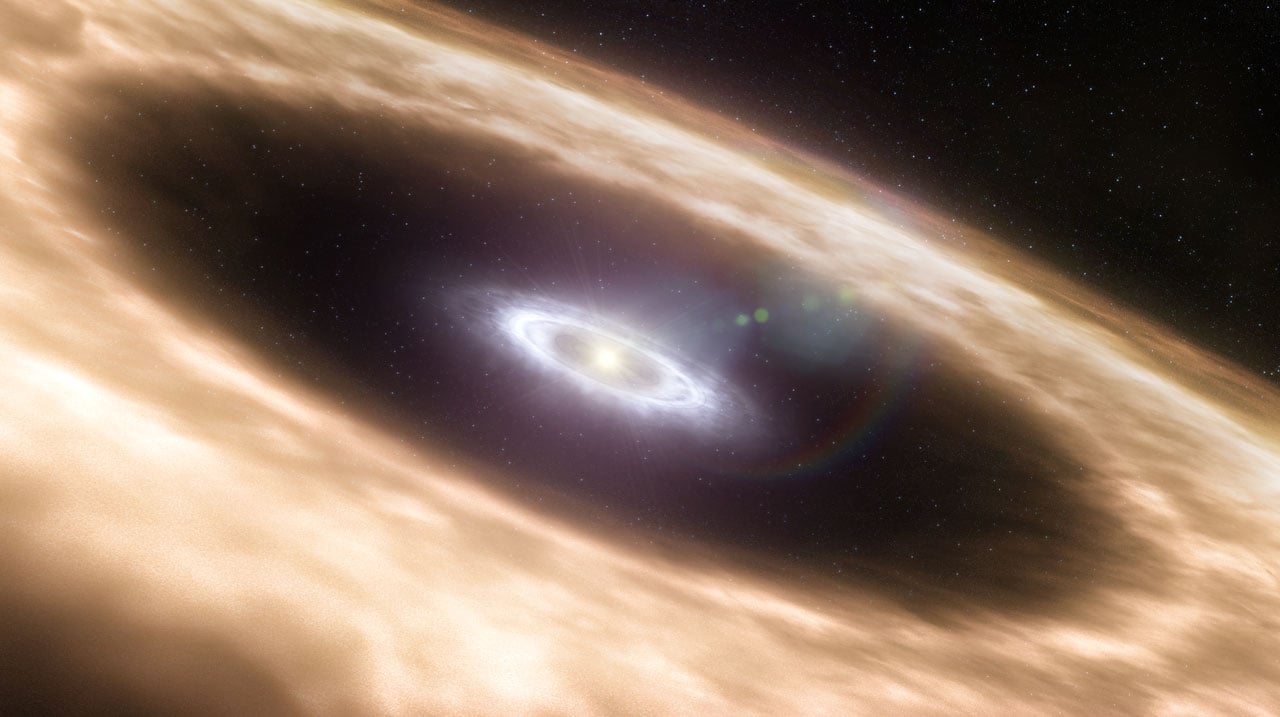
Microgravity Experiments Probe Planetesimal Formation
The Gist
Microgravity flights simulate protoplanetary disk conditions to study planetesimal formation.
Explain Like I'm Five
"Imagine tiny dust bunnies in space bumping into each other to make bigger rocks that become planets. Scientists use special airplanes that go up and down to feel like there's no gravity, so they can watch how the dust bunnies stick together."
Deep Intelligence Analysis
The experiments conducted provide valuable data on how dust particles aggregate and form planetesimals, the building blocks of planets. These findings contribute to refining existing models of planet formation and offer insights into the physical processes governing the evolution of protoplanetary disks. The limitations of short-duration microgravity flights necessitate further research and potentially the development of more advanced simulation techniques to fully capture the complexity of these processes. The implications extend to our understanding of planetary system architecture and the distribution of resources within these systems.
*Transparency Disclosure: This analysis was generated by an AI model. While efforts have been made to ensure accuracy and objectivity, the interpretation and synthesis of information may be subject to limitations inherent in AI technology. Users are encouraged to consult original sources for verification and further context.*
_Context: This intelligence report was compiled by the DailyOrbitalWire Strategy Engine. Verified for Art. 50 Compliance._
Impact Assessment
Understanding planetesimal formation is crucial for comprehending planetary system evolution. Microgravity experiments provide insights into the hydrodynamical instabilities in protoplanetary disks, which are difficult to simulate accurately on Earth.
Read Full Story on Universe TodayKey Details
- ● Experiments used parabolic micro-gravity flights to simulate protoplanetary disk conditions.
- ● The TEMPusVoLa instrument tracked dust particle behavior in a thin gas under vacuum.
- ● Flights achieved 20-30 seconds of weightlessness during dives.
Optimistic Outlook
Further testing based on these experiments could refine our models of planet formation. Improved models may lead to a better understanding of resource distribution in nascent planetary systems, potentially informing future ISRU efforts.
Pessimistic Outlook
Microgravity flights offer limited duration of weightlessness, potentially restricting the scope of experiments. The complexity of protoplanetary disks may require more sophisticated simulations and longer-duration experiments to fully understand planetesimal formation.

The Signal, Not
the Noise|
Get the week's top 1% of space-tech intelligence synthesized into a 5-minute read. Join 25,000+ aerospace insiders.
Unsubscribe anytime. No spam, ever.