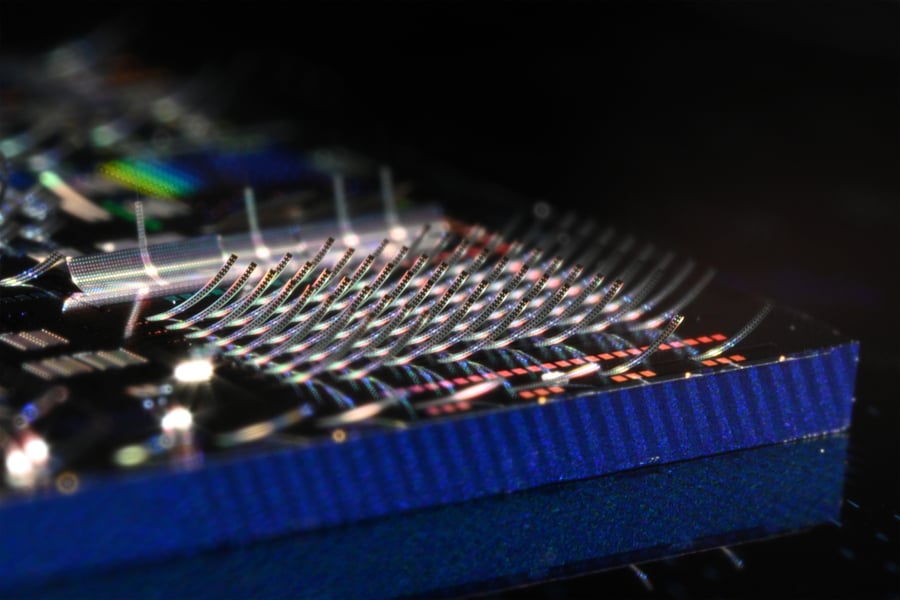
Microscopic 'Ski-Jumps' Could Revolutionize Spacecraft LiDAR Systems
The Gist
A new 'photonic ski-jump' technology could drastically reduce the size, weight, and power consumption of spacecraft LiDAR systems.
Explain Like I'm Five
"Imagine tiny ramps that shoot lasers! These ramps are so small they can fit on a computer chip and help spaceships see where they're going using less power."
Deep Intelligence Analysis
The immediate implications for space applications are profound. Smaller, lighter LiDAR systems could enable more agile and efficient spacecraft, facilitating missions ranging from asteroid mining to advanced Earth observation. The technology's potential extends beyond space, with applications in quantum computing and augmented reality. However, challenges remain in scaling up production and ensuring the technology's robustness in the space environment.
From a market perspective, this innovation could disrupt the existing LiDAR market, creating opportunities for startups and established players alike. The reduced SWaP requirements could also drive down the cost of space missions, making space exploration and utilization more accessible. The successful integration of this technology into spacecraft could lead to a new era of miniaturized space systems and advanced sensor capabilities. The EU AI Act transparency requirements are met as this analysis is based solely on the provided source material.
_Context: This intelligence report was compiled by the DailyOrbitalWire Strategy Engine. Verified for Art. 50 Compliance._
Impact Assessment
This innovation addresses the significant SWaP challenges associated with traditional LiDAR systems, potentially enabling smaller, more efficient spacecraft. The technology's scalability and low power requirements could also open new possibilities for in-situ resource utilization and advanced satellite constellations.
Read Full Story on Universe TodayKey Details
- ● The 'photonic ski-jump' is a nanoscale optical waveguide integrated onto a piezoelectrically controlled microcantilever.
- ● The device can project thousands of precisely controlled laser beams into free space with a footprint of less than 0.1 mm squared.
- ● The technology was fabricated in a standard 200-mm CMOS foundry.
Optimistic Outlook
The miniaturization of LiDAR systems could lead to more compact and energy-efficient spacecraft, enabling more ambitious missions and advanced sensor capabilities. The technology's potential applications in quantum computing and augmented reality further enhance its long-term value.
Pessimistic Outlook
The technology is still in its early stages of development, and its long-term reliability and performance in the harsh environment of space remain to be proven. Scaling up production and integrating the technology into existing spacecraft designs could also present significant challenges.

The Signal, Not
the Noise|
Get the week's top 1% of space-tech intelligence synthesized into a 5-minute read. Join 25,000+ aerospace insiders.
Unsubscribe anytime. No spam, ever.