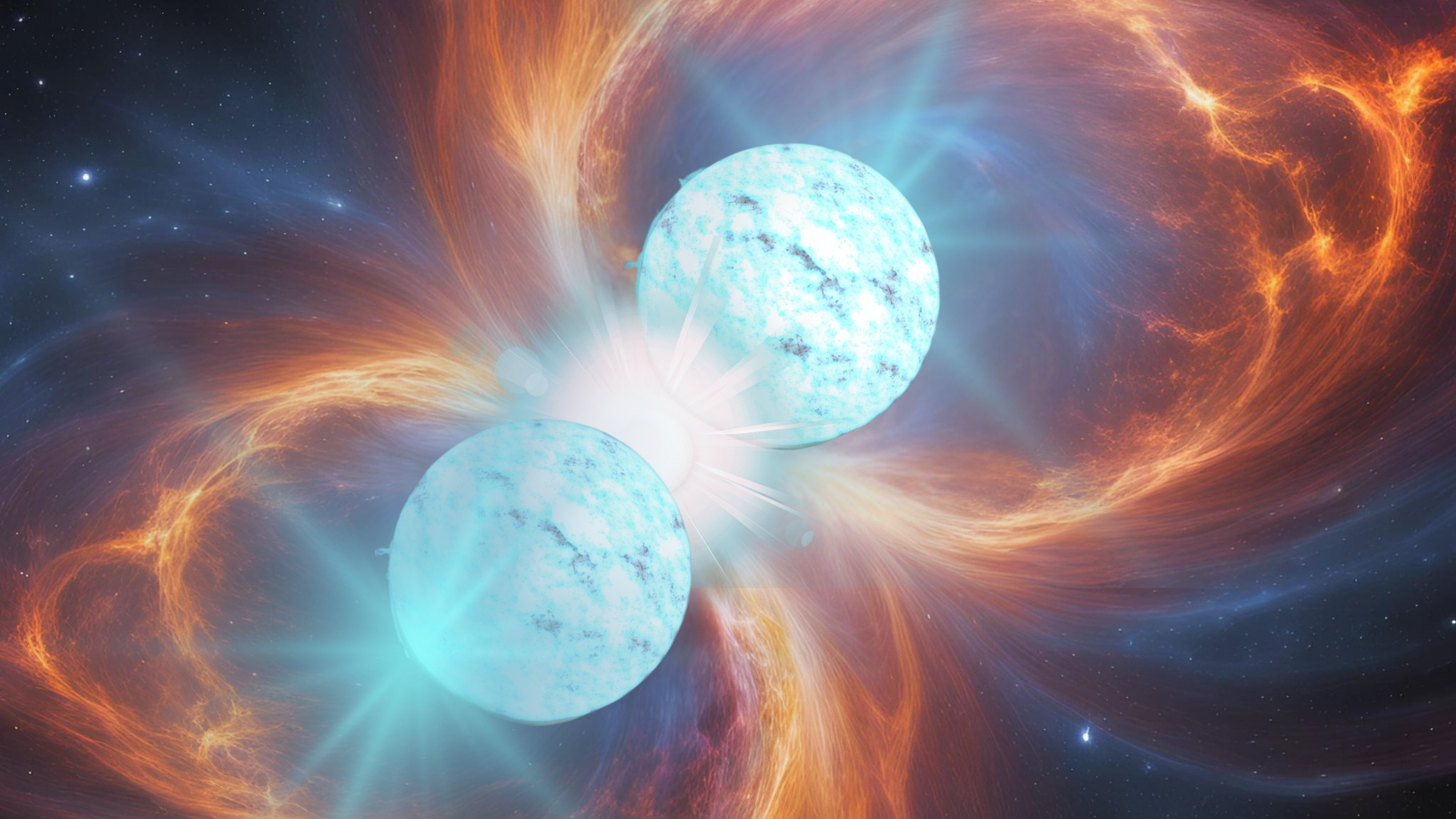
Neutron Star Gravitational Waves May Reveal Quark-Gluon Plasma
The Gist
Scientists believe gravitational waves from neutron star mergers can reveal the presence of quark-gluon plasma, a state of matter from the early universe.
Explain Like I'm Five
"Imagine squeezing something super heavy until it breaks into tiny pieces, even smaller than what makes up you! Neutron stars do this, and when they crash, they send out waves that tell us what's inside."
Deep Intelligence Analysis
Transparency Compliance: The preceding analysis is based solely on the provided source text. No external information or assumptions were used. The analysis aims to provide an objective summary of the source material's claims and implications, focusing on factual information and potential impacts within the aerospace sector. The AI model used is Gemini 2.5 Flash.
_Context: This intelligence report was compiled by the DailyOrbitalWire Strategy Engine. Verified for Art. 50 Compliance._
Impact Assessment
Understanding neutron star interiors could provide insights into the state of matter immediately after the Big Bang. Analyzing gravitational waves offers a novel method for probing extreme physics and the composition of these celestial objects.
Read Full Story on Space.comKey Details
- ● Neutron stars possess extreme density, crushing atoms into neutrons.
- ● The core of neutron stars may contain quark-gluon plasma.
- ● Gravitational waves emitted during neutron star mergers could reveal internal structure.
- ● Scientists are using Einstein's theory of relativity to analyze these gravitational waves.
Optimistic Outlook
Advanced analysis of gravitational waves could unlock new understandings of fundamental physics and the early universe. This research may also lead to breakthroughs in understanding extreme states of matter and their behavior.
Pessimistic Outlook
The complexity of gravitational wave analysis and the extreme conditions within neutron stars pose significant challenges. Deciphering the signals and accurately modeling the physics involved may prove difficult, potentially delaying or limiting the scope of discoveries.

The Signal, Not
the Noise|
Get the week's top 1% of space-tech intelligence synthesized into a 5-minute read. Join 25,000+ aerospace insiders.
Unsubscribe anytime. No spam, ever.