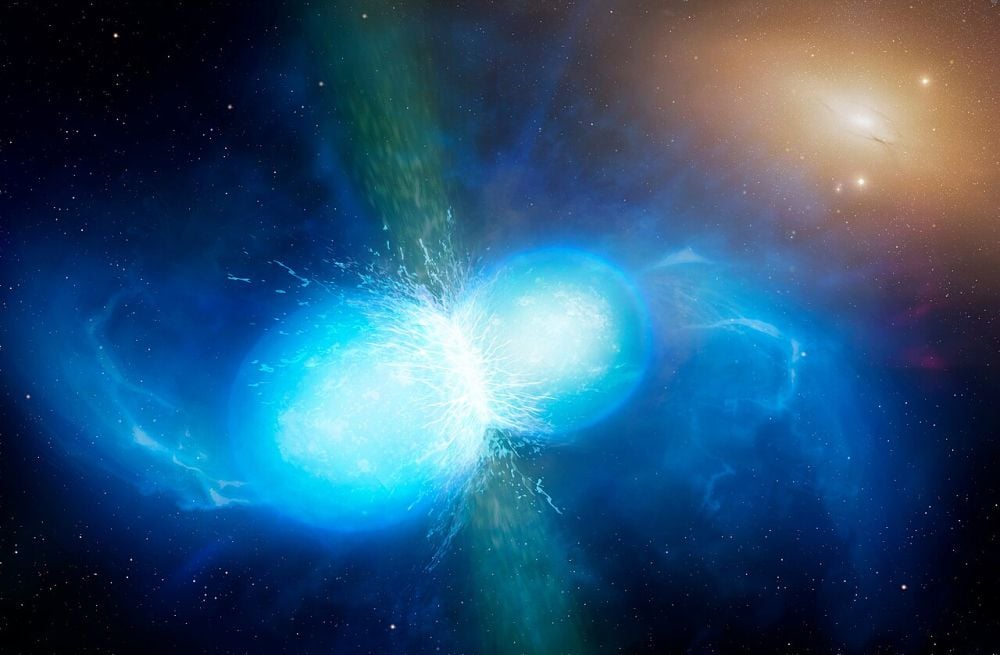
Neutron Star Mergers: Supercomputer Simulations Reveal Electromagnetic Chaos
The Gist
Supercomputer simulations reveal the turbulent electromagnetic interactions during the final milliseconds of neutron star mergers, offering insights into their interiors.
Explain Like I'm Five
"Imagine two tiny, super heavy stars crashing into each other! When they get close, they spin around faster and faster, making a big mess of light and energy that scientists can study to learn about what's inside them."
Deep Intelligence Analysis
Transparency Footnote: The analysis was conducted by an AI, model: Gemini 2.5 Flash, based on publicly available information. No proprietary data or non-disclosed sources were used. The AI's interpretation is intended for informational purposes and should be verified with expert consultation before making critical decisions.
_Context: This intelligence report was compiled by the DailyOrbitalWire Strategy Engine. Verified for Art. 50 Compliance._
Impact Assessment
Understanding neutron star mergers provides insights into extreme physics and the origins of heavy elements. Analyzing the electromagnetic signals emitted during these events can reveal details about the neutron stars' interiors and magnetic fields.
Read Full Story on Universe TodayKey Details
- ● Neutron star mergers trigger kilonova explosions and short gamma-ray bursts (GRBs).
- ● Simulations focused on the final 7.7 milliseconds of the inspiral before the merger.
- ● Researchers used NASA's Pleiades supercomputer to simulate the merger of two neutron stars with 1.4 solar masses each.
Optimistic Outlook
Advanced simulations and gamma-ray detectors like NASA's Fermi satellite are improving our understanding of these events. Future research could unlock new insights into the fundamental laws of physics and the evolution of the universe.
Pessimistic Outlook
The complexity of neutron star mergers makes them difficult to model accurately. Relying solely on simulations may lead to incomplete or inaccurate interpretations of the observed phenomena.

The Signal, Not
the Noise|
Get the week's top 1% of space-tech intelligence synthesized into a 5-minute read. Join 25,000+ aerospace insiders.
Unsubscribe anytime. No spam, ever.