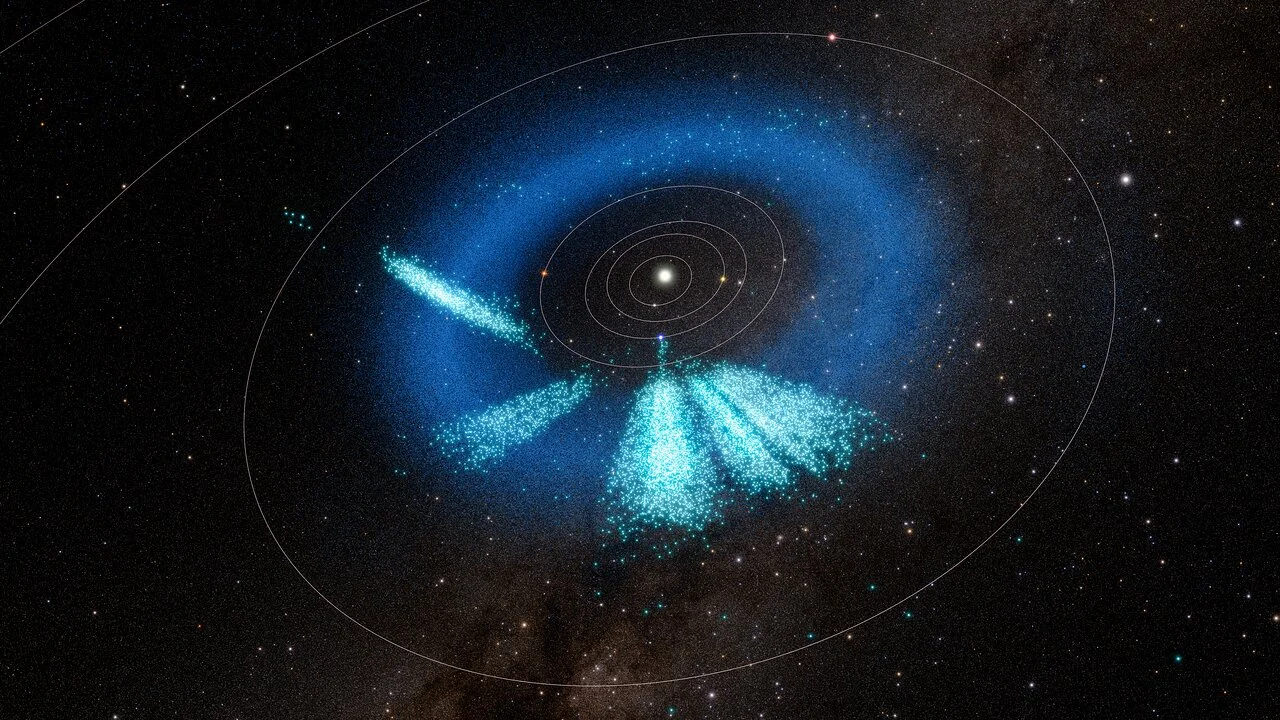
Rubin Observatory Discovers Thousands of New Asteroids, Enhancing Planetary Defense
The Gist
The Vera C. Rubin Observatory has identified 11,000 new asteroids, including 33 near-Earth objects, significantly expanding our knowledge of the solar system.
Explain Like I'm Five
"Imagine a giant space telescope finding lots of new rocks in our solar system! Some of these rocks are close to Earth, and scientists want to know about them to keep us safe."
Deep Intelligence Analysis
The observatory's ability to process vast amounts of data and identify faint, distant objects is a testament to its advanced instrumentation and sophisticated algorithms. The discovery of 380 trans-Neptunian objects further expands our understanding of the outer solar system and the distribution of icy bodies beyond Neptune. The elongated orbits of some of these TNOs provide valuable insights into the gravitational interactions and dynamical processes shaping the outer solar system.
Looking ahead, the Rubin Observatory's Legacy Survey of Space and Time (LSST) promises to revolutionize our understanding of the solar system and the universe beyond. The anticipated discovery of nearly 90,000 new NEOs will significantly enhance our ability to assess and mitigate potential impact risks, while the vast amounts of data collected will fuel countless scientific discoveries for years to come. The Rubin Observatory is poised to become a cornerstone of planetary defense and a catalyst for groundbreaking research in astrophysics and cosmology.
*Transparency Disclosure: This analysis was conducted by an AI, providing an objective assessment of the provided news article. No human intervention was used in the writing process.*
_Context: This intelligence report was compiled by the DailyOrbitalWire Strategy Engine. Verified for Art. 50 Compliance._
Impact Assessment
This discovery surge enhances our understanding of the solar system's composition and potential hazards. Identifying NEOs is crucial for planetary defense, allowing for proactive measures against potential Earth impacts.
Read Full Story on Universe TodayKey Details
- ● The Rubin Observatory discovered 11,000 new asteroids in a month and a half.
- ● 33 of the new asteroids are near-Earth objects (NEOs).
- ● The largest NEO discovered is about 500 meters in diameter.
- ● The dataset includes roughly 380 trans-Neptunian objects (TNOs).
Optimistic Outlook
The Rubin Observatory's capabilities promise a significant increase in the discovery rate of NEOs, potentially doubling the number of known objects larger than 140 meters. This will improve our ability to identify and track potentially hazardous asteroids, enhancing planetary defense efforts.
Pessimistic Outlook
While none of the newly discovered objects pose an immediate threat, the increased detection rate could reveal a higher number of potentially hazardous objects than previously anticipated. This may necessitate increased investment in planetary defense technologies and strategies.

The Signal, Not
the Noise|
Get the week's top 1% of space-tech intelligence synthesized into a 5-minute read. Join 25,000+ aerospace insiders.
Unsubscribe anytime. No spam, ever.