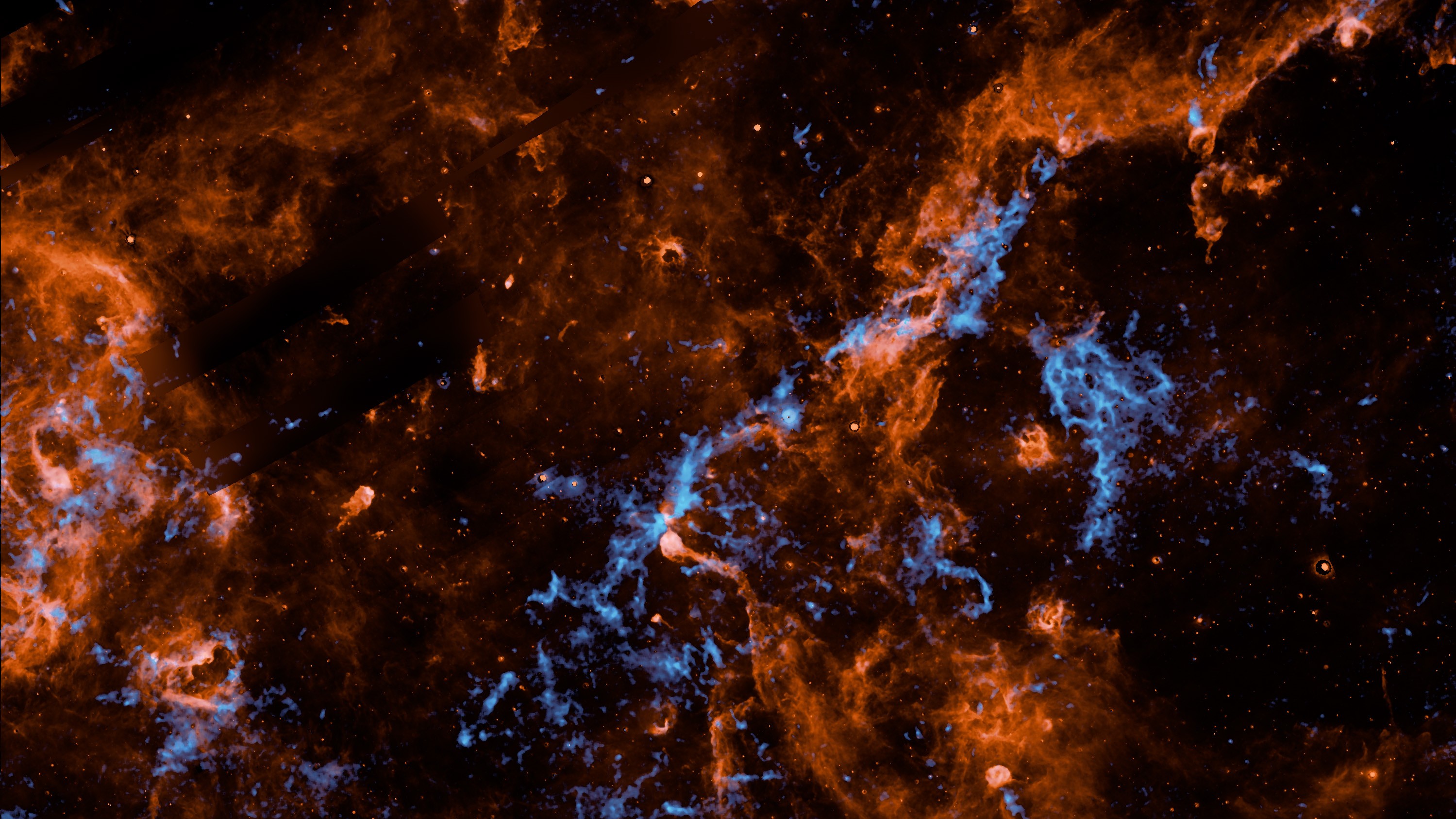
SPHEREx Maps 'Interstellar Glaciers' of Galactic Ice
The Gist
NASA's SPHEREx mission maps vast regions of interstellar ice, crucial for understanding water's origin and potential life support.
Explain Like I'm Five
"SPHEREx is like a cosmic ice detective, finding giant frozen clouds in space that might give water to new planets!"
Deep Intelligence Analysis
The mission's findings suggest that these 'interstellar glaciers' could deliver a massive water supply to new solar systems, potentially supporting the emergence of life on nascent planets. SPHEREx's spectral capabilities allow it to measure the amounts of various ices and molecules, providing valuable insights into the composition and environment of molecular clouds. Unlike previous telescopes, SPHEREx is specifically designed to conduct a large-scale spectral survey of the entire sky, offering an unprecedented view of the distribution of icy molecules.
Managed by JPL, SPHEREx launched in March 2025 and has completed its first all-sky infrared map. The mission's data is helping scientists understand the origins of water and the conditions necessary for life to arise. The discovery of these vast ice regions underscores the importance of interstellar dust and molecular clouds in the formation of planets and the potential for life beyond Earth.
_Context: This intelligence report was compiled by the DailyOrbitalWire Strategy Engine. Verified for Art. 50 Compliance._
Impact Assessment
The discovery of these 'interstellar glaciers' provides insight into the formation and distribution of water in the universe. This knowledge is vital for understanding the potential for life on other planets.
Read Full Story on NASA Breaking NewsKey Details
- ● SPHEREx mapped ice regions over 600 light-years across.
- ● SPHEREx launched March 11, 2025.
- ● SPHEREx can observe the sky in 102 infrared wavelengths.
- ● The study was published in The Astrophysical Journal.
Optimistic Outlook
SPHEREx's detailed maps of interstellar ice could pinpoint regions ripe for new solar system formation, potentially guiding future exploration efforts. The mission's spectral capabilities promise a deeper understanding of molecular cloud composition.
Pessimistic Outlook
The reliance on infrared detection may limit the scope of SPHEREx's observations, potentially missing crucial data hidden by dust. The interpretation of spectral data requires complex models, which could introduce uncertainties.

The Signal, Not
the Noise|
Get the week's top 1% of space-tech intelligence synthesized into a 5-minute read. Join 25,000+ aerospace insiders.
Unsubscribe anytime. No spam, ever.