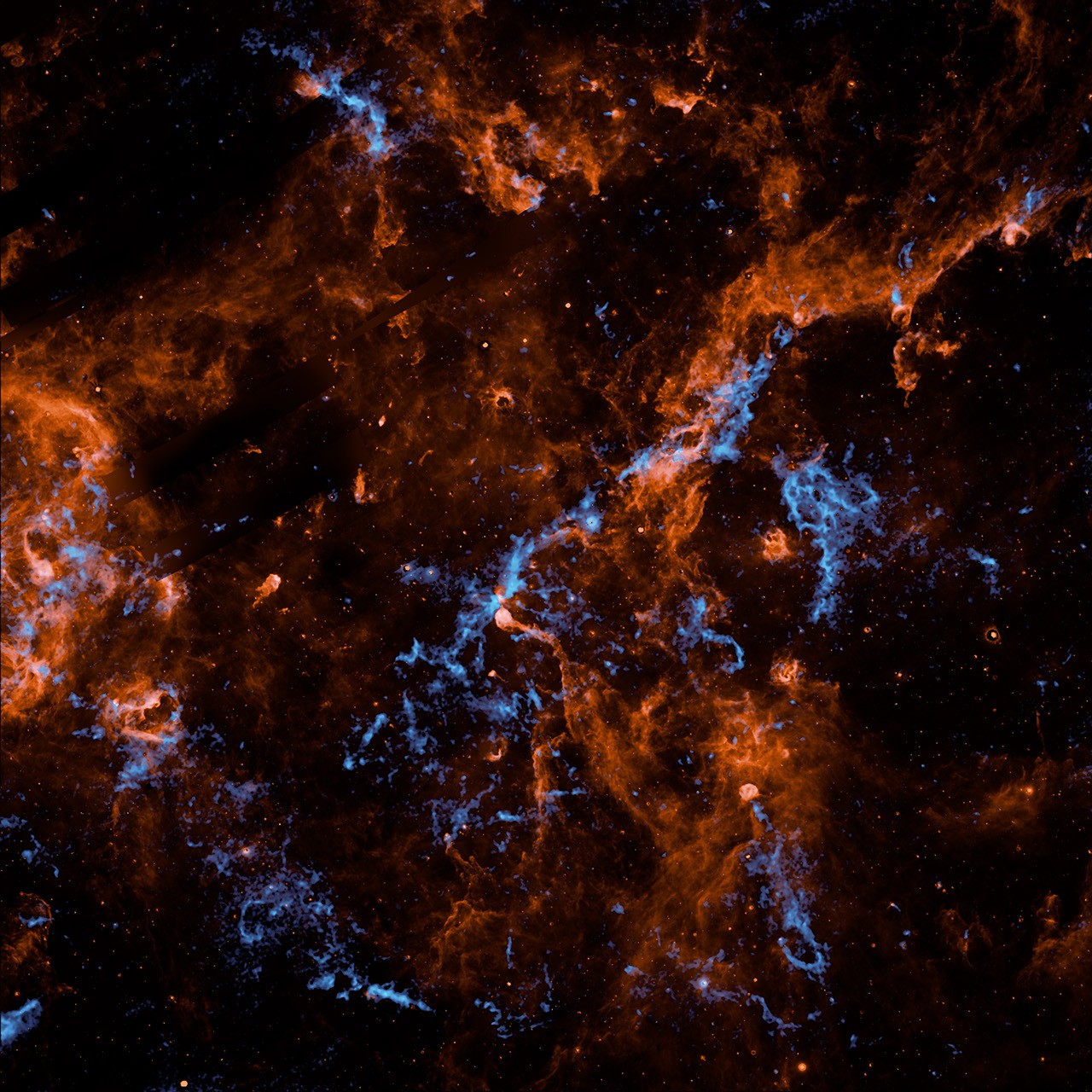
SPHEREx Maps Water Ice in Star-Forming Region
The Gist
NASA's SPHEREx mission has mapped water ice and polycyclic aromatic hydrocarbons in the Cygnus X region.
Explain Like I'm Five
"SPHEREx is like a special camera that sees light we can't, and it's making a map of where water ice is in space, which helps us understand how planets are made!"
Deep Intelligence Analysis
The mission's findings are significant because they provide insights into the origins of water and the conditions necessary for life to emerge. The detection of water ice in dense regions of dust suggests that these areas serve as reservoirs for water molecules, potentially contributing to the formation of oceans on nascent planets. SPHEREx's large-scale spectral survey is the first of its kind, offering a comprehensive view of the distribution of icy molecules throughout the galaxy.
Managed by JPL, with contributions from BAE Systems and a team of scientists across multiple institutions, SPHEREx represents a collaborative effort to unravel the mysteries of the cosmos. The freely available dataset ensures that scientists and the public can access and utilize the mission's findings for further research and exploration. The mission's success underscores the importance of infrared astronomy in studying the composition and evolution of galaxies and the potential for discovering new insights into the origins of life.
_Context: This intelligence report was compiled by the DailyOrbitalWire Strategy Engine. Verified for Art. 50 Compliance._
Impact Assessment
The SPHEREx mission provides crucial data on the distribution of water ice in star-forming regions. This data helps understand the origins of water and the conditions for life in the universe.
Read Full Story on NASA Breaking NewsKey Details
- ● SPHEREx launched March 11, 2025.
- ● SPHEREx can observe the sky in 102 infrared wavelengths.
- ● The study was published April 15, 2026, in The Astrophysical Journal.
- ● SPHEREx completed its first all-sky infrared map by late 2025.
Optimistic Outlook
SPHEREx's ability to map the entire sky in multiple infrared wavelengths will likely lead to further discoveries about the composition and distribution of interstellar molecules. This could accelerate our understanding of planet formation and the potential for life beyond Earth.
Pessimistic Outlook
The reliance on infrared observations may limit the detection of certain molecules or features obscured by dust. Further, the data analysis relies on complex models, which could introduce uncertainties in the interpretation of the results.

The Signal, Not
the Noise|
Get the week's top 1% of space-tech intelligence synthesized into a 5-minute read. Join 25,000+ aerospace insiders.
Unsubscribe anytime. No spam, ever.