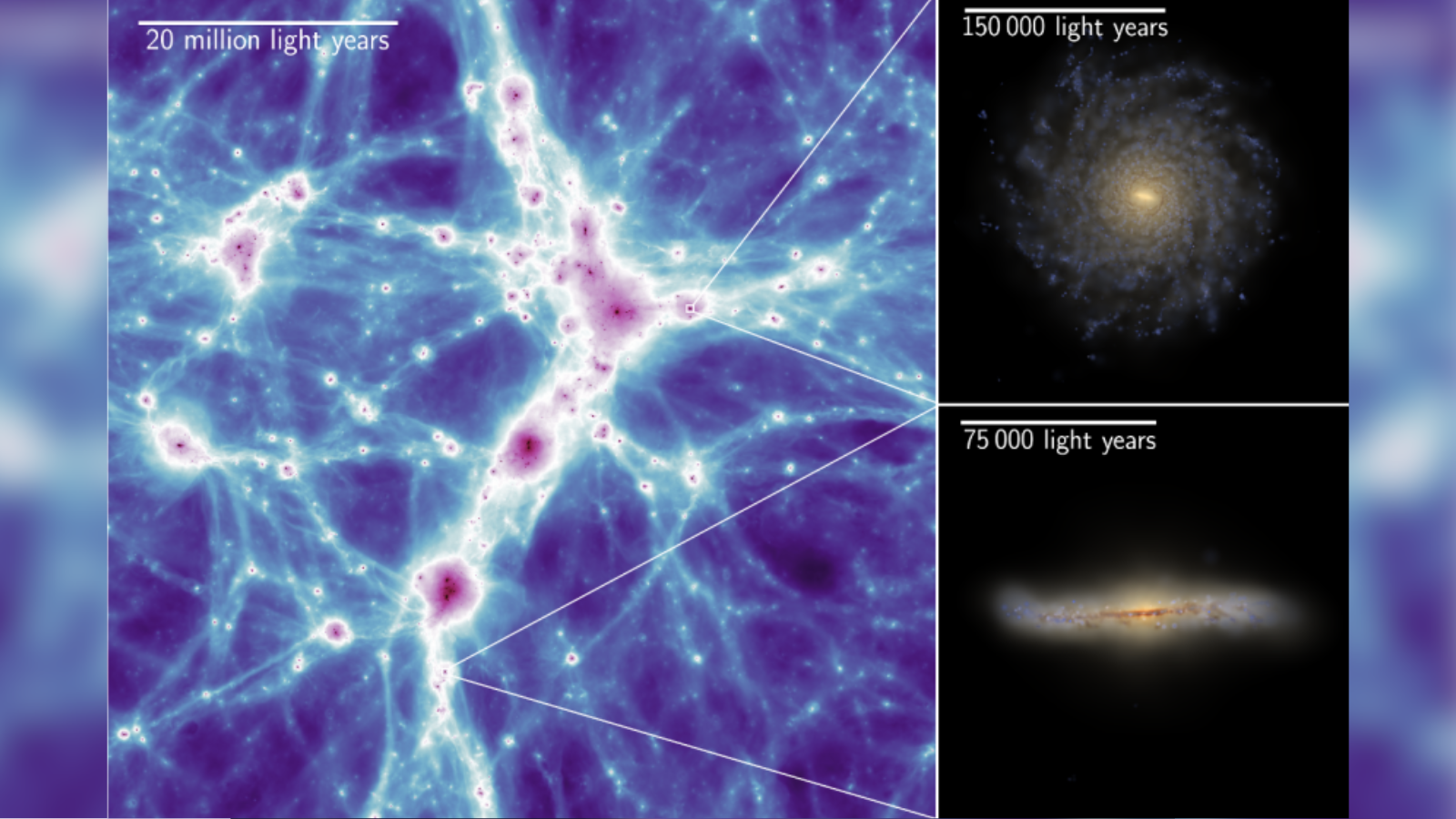
Synthetic Universe Simulates Early Galaxy Evolution
The Gist
A new audiovisual simulation, COLIBRE, models galaxy evolution from the early universe, closely resembling JWST observations.
Explain Like I'm Five
"Imagine a video game that shows how galaxies were born and changed over billions of years, helping scientists understand the universe's baby pictures."
Deep Intelligence Analysis
However, the simulation's inability to explain the 'little red dots' highlights the ongoing challenges in understanding the early universe. These enigmatic objects, observed in abundance during a specific period of cosmic time, suggest that there are still missing pieces in our understanding of galaxy formation and black hole seeding. Future research will likely focus on refining these simulations to incorporate these missing elements and provide a more complete picture of cosmic evolution.
The use of the COSMA8 supercomputer underscores the computational demands of such simulations. As computing power continues to increase, future simulations will likely be able to incorporate even more complex physics and cover larger volumes of space, leading to further breakthroughs in our understanding of the universe.
_Context: This intelligence report was compiled by the DailyOrbitalWire Strategy Engine. Verified for Art. 50 Compliance._
Impact Assessment
This simulation validates the standard cosmological model (LCDM) and provides insights into early galaxy formation. It allows astronomers to study cosmic evolution in detail and compare simulations with real observations.
Read Full Story on Space.comKey Details
- ● COLIBRE simulates cold galactic dust and gas dynamics from 1 billion years post-Big Bang.
- ● The simulation runs on the COSMA8 supercomputer at Durham University.
- ● COLIBRE accurately models cold gas, crucial for star formation, overcoming previous simulation limitations.
Optimistic Outlook
Improved simulations like COLIBRE could lead to a more complete understanding of the universe's evolution. Future simulations may resolve current discrepancies, such as the origin of 'little red dots'.
Pessimistic Outlook
The simulation cannot yet explain the origin of 'little red dots' observed by JWST, indicating gaps in our understanding. Computational limitations may still restrict the accuracy and scope of such simulations.

The Signal, Not
the Noise|
Get the week's top 1% of space-tech intelligence synthesized into a 5-minute read. Join 25,000+ aerospace insiders.
Unsubscribe anytime. No spam, ever.