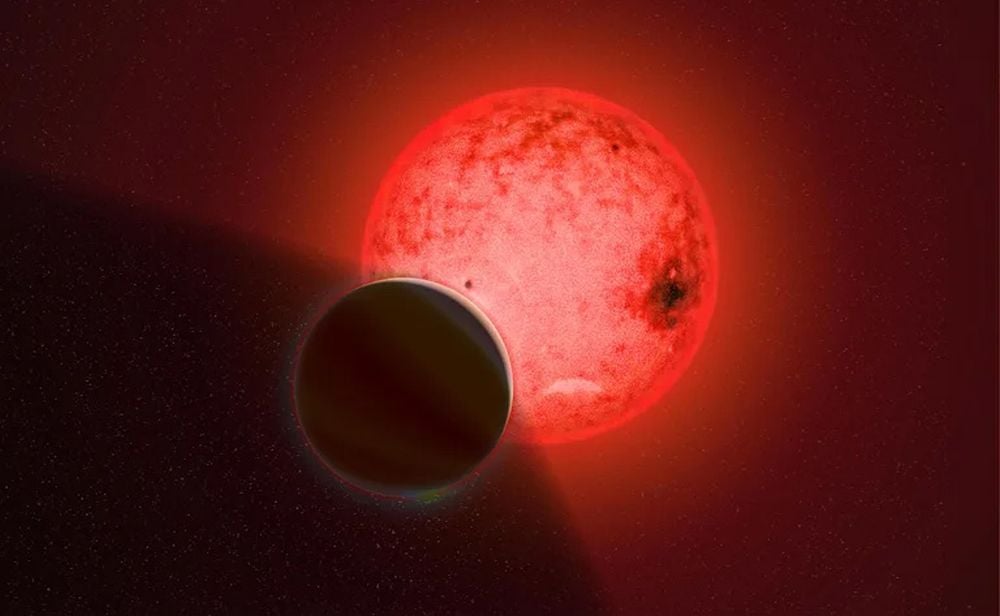
Exoplanet TOI-5205b Challenges Planet Formation Theories
The Gist
A Jupiter-sized exoplanet, TOI-5205b, orbits a small M-dwarf star, challenging conventional planet formation theories.
Explain Like I'm Five
"Imagine a tiny star with a giant planet like Jupiter super close to it! Scientists are scratching their heads because it's like a small dog having a baby elephant – it shouldn't happen, but it does!"
Deep Intelligence Analysis
The JWST's observations of TOI-5205b's atmosphere have revealed a lower concentration of metals compared to Jupiter and its host star. This finding further complicates the picture, suggesting that the planet's formation process may have differed significantly from that of gas giants in our solar system. The GEMS program, which focuses on studying giant exoplanets around M-dwarf stars, aims to shed light on these anomalies and refine our understanding of planet formation.
While the existence of TOI-5205b challenges existing theories, it also presents an opportunity to expand our knowledge of planetary systems. Further observations of similar exoplanets could reveal new pathways for planet formation and the diversity of planetary systems. However, it is also possible that TOI-5205b represents a rare phenomenon, making it difficult to generalize findings. Nevertheless, the study of this exoplanet and others like it is crucial for advancing our understanding of the universe and our place within it.
*Transparency: This analysis was generated by an AI model to provide an objective summary and interpretation of the provided source content.*
_Context: This intelligence report was compiled by the DailyOrbitalWire Strategy Engine. Verified for Art. 50 Compliance._
Impact Assessment
The existence of TOI-5205b challenges the nebular hypothesis, which struggles to explain how such massive planets form around low-mass stars. JWST's study of its atmosphere provides insights into exoplanet formation and composition.
Read Full Story on Universe TodayKey Details
- ● TOI-5205b has 1.08 Jupiter masses and orbits an M-dwarf star 282 light-years away.
- ● Its orbital period is 1.6 days.
- ● The host star has 0.392 ± 0.015 solar masses.
- ● JWST observations reveal TOI-5205b's atmosphere has lower metallicity than Jupiter and its star.
Optimistic Outlook
Further JWST observations of similar exoplanets could refine planet formation models. Understanding these anomalies may reveal new pathways for planet formation and the diversity of planetary systems.
Pessimistic Outlook
Current models may be incomplete, potentially limiting our understanding of exoplanet formation. The unusual characteristics of TOI-5205b may represent a rare phenomenon, making it difficult to generalize findings.

The Signal, Not
the Noise|
Get the week's top 1% of space-tech intelligence synthesized into a 5-minute read. Join 25,000+ aerospace insiders.
Unsubscribe anytime. No spam, ever.