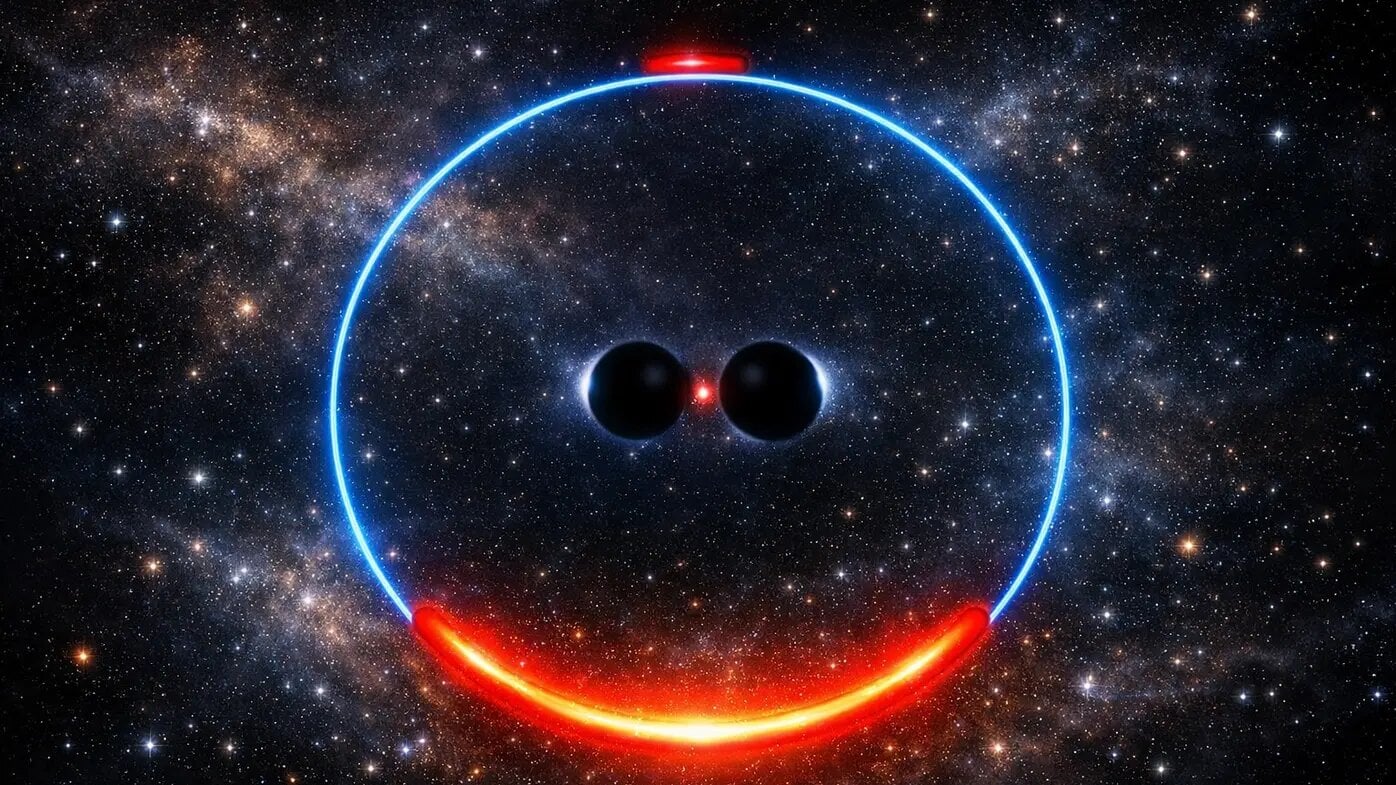
Detecting Supermassive Black Hole Binaries via Starlight Flashes
The Gist
New study proposes detecting supermassive black hole binaries through quasiperiodic starlight flashes caused by gravitational lensing.
Explain Like I'm Five
"Imagine two giant black holes dancing around each other. Sometimes, they bend the light from stars behind them, making the stars look brighter for a short time. Scientists can find these dancing black holes by looking for these bright flashes!"
Deep Intelligence Analysis
_Context: This intelligence report was compiled by the DailyOrbitalWire Strategy Engine. Verified for Art. 50 Compliance._
Impact Assessment
Detecting these binaries will allow astronomers to study the dynamics of galaxy mergers and the evolution of supermassive black holes. It could also provide insights into gravitational wave astronomy.
Read Full Story on Universe TodayKey Details
- ● Supermassive black hole binaries form when galaxies merge.
- ● The Vera Rubin Observatory will capture images of thousands of galaxies every few days.
- ● Flashes should occur within periods of less than a decade.
Optimistic Outlook
The Vera Rubin Observatory's frequent imaging capabilities offer a promising avenue for detecting these starlight flashes. This could lead to a breakthrough in understanding supermassive black hole binaries and their role in galactic evolution.
Pessimistic Outlook
The quasiperiodic nature of the flashes and the movement of stars and black holes make detection challenging. It requires long-term observation and sophisticated data analysis to distinguish genuine signals from background noise.

The Signal, Not
the Noise|
Get the week's top 1% of space-tech intelligence synthesized into a 5-minute read. Join 25,000+ aerospace insiders.
Unsubscribe anytime. No spam, ever.