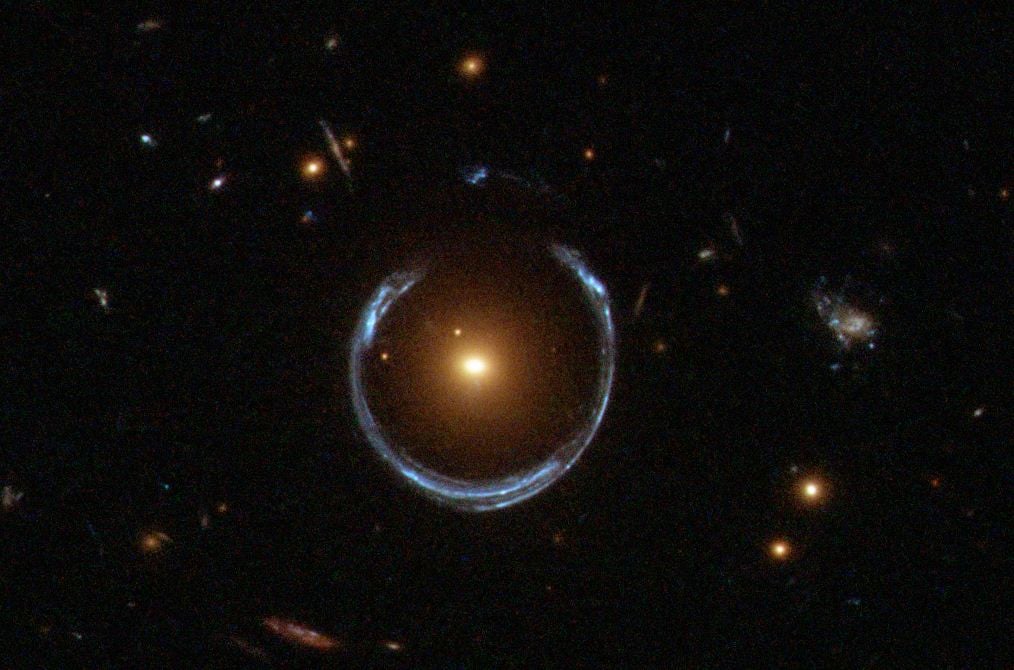
Citizen Scientists Needed to Find Gravitational Lenses in Euclid Data
The Gist
Citizen scientists are invited to help find gravitational lenses in the Euclid telescope's new dataset.
Explain Like I'm Five
"Imagine a magnifying glass, but instead of glass, it's a giant galaxy bending light from another galaxy far away. Scientists need your help to find these 'magnifying glasses' in space pictures!"
Deep Intelligence Analysis
*Transparency Footnote: The AI-generated content in this analysis was produced by a model trained on publicly available scientific data and news articles related to space exploration and astronomy. The analysis aims to provide an objective summary and interpretation of the source material, focusing on key facts and potential implications for the aerospace sector. No proprietary information or confidential data was used in the generation of this content.*
_Context: This intelligence report was compiled by the DailyOrbitalWire Strategy Engine. Verified for Art. 50 Compliance._
Impact Assessment
Gravitational lenses help measure galaxy mass, including dark matter, and trace the universe's expansion. Citizen science projects like Space Warps democratize astronomical discovery and accelerate research.
Read Full Story on Universe TodayKey Details
- ● Euclid surveyed roughly 72 million galaxies.
- ● AI pre-selected 300,000 candidate images.
- ● Scientists hope to find over 10,000 new lenses.
- ● Analysis of 0.04% of data found 500 lenses.
Optimistic Outlook
Increased participation in Space Warps could lead to a significant increase in discovered gravitational lenses. This will refine models of dark matter distribution and the accelerating expansion of the universe, enhancing our understanding of fundamental cosmological parameters.
Pessimistic Outlook
The reliance on citizen scientists introduces potential for data quality issues and biases. The sheer volume of data may overwhelm volunteers, slowing down the analysis process and potentially missing subtle but important lensing events.

The Signal, Not
the Noise|
Get the week's top 1% of space-tech intelligence synthesized into a 5-minute read. Join 25,000+ aerospace insiders.
Unsubscribe anytime. No spam, ever.