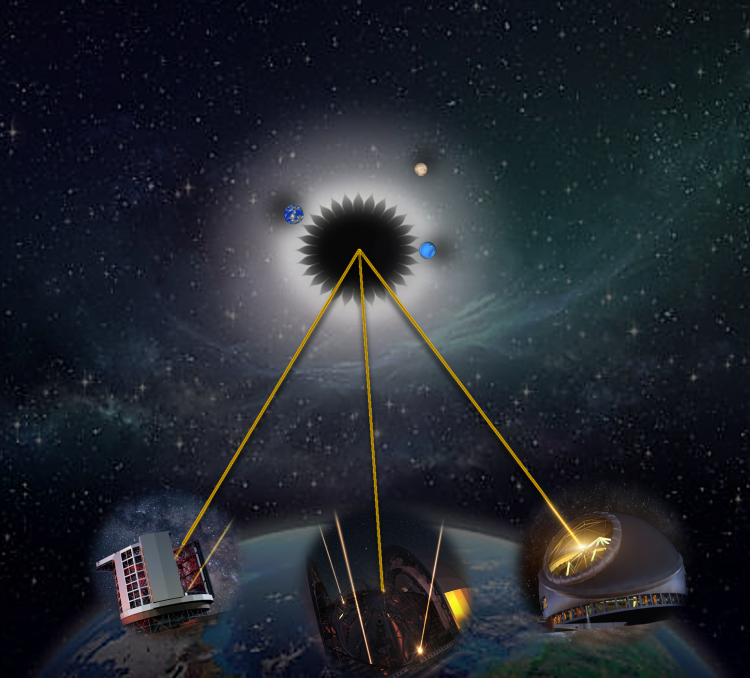
Hybrid Observatory Concept Aims to Directly Image Earth-like Exoplanets
The Gist
A hybrid ground-space observatory concept using a starshade could identify Earth-like exoplanets by blocking star glare and utilizing powerful ground-based telescopes.
Explain Like I'm Five
"Imagine a giant umbrella in space blocks the sun's glare so big telescopes on Earth can see planets like our own!"
Deep Intelligence Analysis
The advantage of this hybrid approach lies in its potential to overcome limitations associated with each individual method. Space-based telescopes avoid atmospheric turbulence, but are costly to build and deploy. Ground-based telescopes are more accessible but suffer from atmospheric distortion. By combining a space-based starshade with advanced adaptive optics on ground-based telescopes, HOEE aims to mitigate these challenges and achieve high-resolution imaging of exoplanets. The ability to identify dozens of Earth-sized exoplanets and detect potential biosignatures within hours would be a major breakthrough in exoplanet research.
However, the success of HOEE hinges on several factors. Precise alignment and coordination between the starshade and ground-based telescopes are crucial. Furthermore, the effectiveness of adaptive optics in correcting atmospheric turbulence under varying weather conditions needs to be thoroughly evaluated. Despite these challenges, the potential scientific return from HOEE is immense, offering a pathway to characterize potentially habitable exoplanets and search for signs of life beyond our solar system. This could revolutionize our understanding of planetary formation, the prevalence of Earth-like worlds, and the potential for life elsewhere in the universe.
*Transparency Statement: This analysis was generated by an AI model and reviewed by a human editor. All information is derived from the provided source material.*
_Context: This intelligence report was compiled by the DailyOrbitalWire Strategy Engine. Verified for Art. 50 Compliance._
Impact Assessment
Direct imaging of exoplanets is crucial for identifying potentially habitable worlds. This hybrid approach could accelerate the discovery of Earth-like planets and potential biosignatures, informing future space exploration and resource utilization strategies.
Read Full Story on Universe TodayKey Details
- ● The proposed starshade measures 99 meters in diameter.
- ● The concept uses the Extremely Large Telescope (ELT), Giant Magellan Telescope (GMT), and Thirty Meter Telescope (TMT).
- ● The system aims to identify dozens of Earth-sized exoplanets.
- ● The system can identify entire solar systems in minutes and biosignatures in hours.
- ● HOEE can observe at an angle as small as 0.058 milliarcseconds from the star.
Optimistic Outlook
The hybrid observatory could significantly enhance exoplanet detection capabilities, potentially leading to the discovery of multiple Earth-like planets in the near future. The ability to identify biosignatures quickly could revolutionize our understanding of life beyond Earth and inform future astrobiology missions.
Pessimistic Outlook
The project relies on the successful deployment and coordination of both space-based and ground-based assets, which presents significant technical and logistical challenges. Atmospheric turbulence, even with adaptive optics, could still limit the effectiveness of ground-based telescopes, hindering the detection of faint biosignatures.

The Signal, Not
the Noise|
Get the week's top 1% of space-tech intelligence synthesized into a 5-minute read. Join 25,000+ aerospace insiders.
Unsubscribe anytime. No spam, ever.