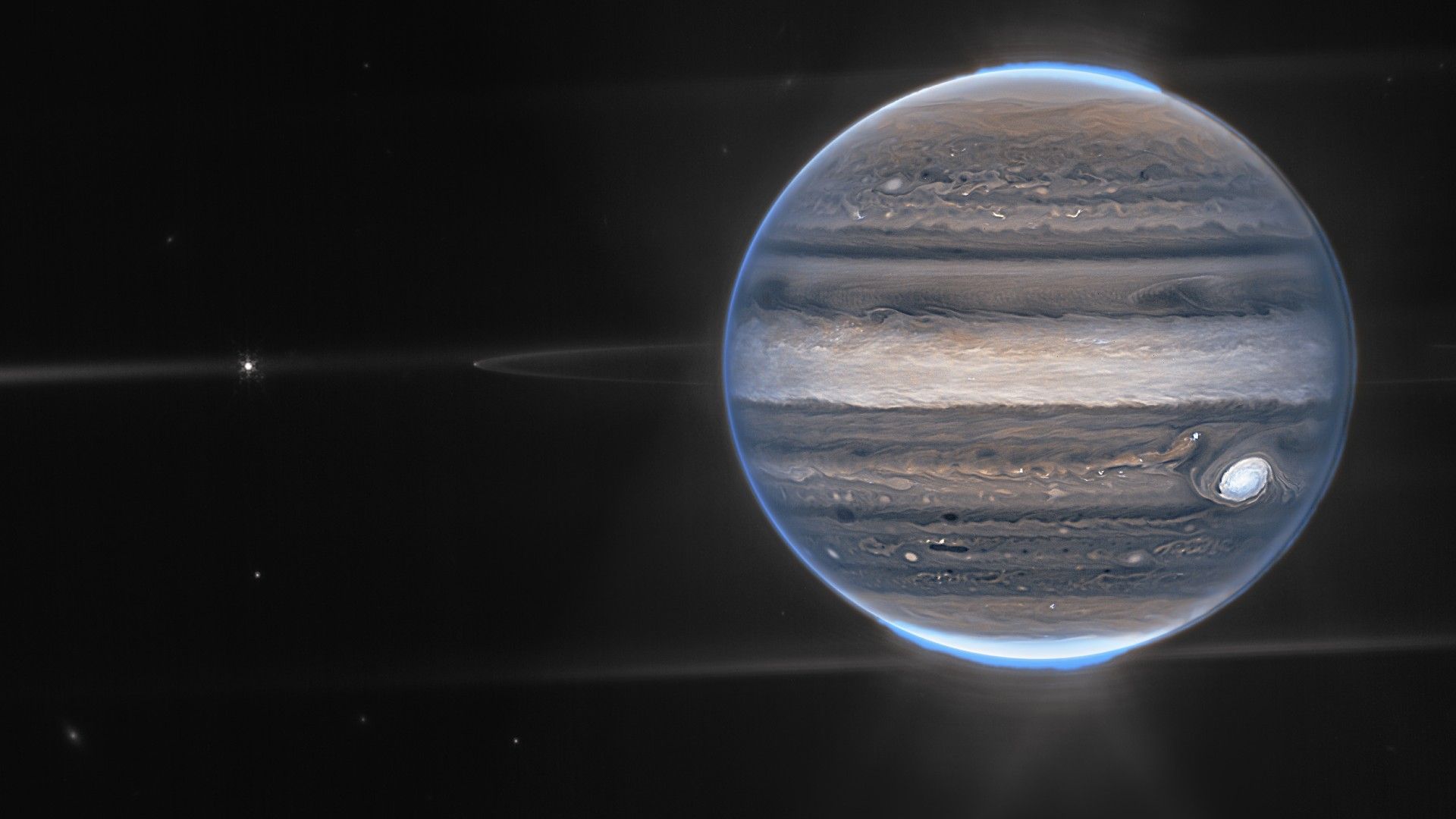
JWST Spots Cold 'Footprints' of Jupiter's Moons in Auroras
The Gist
The James Webb Space Telescope detected cold spots and increased ion density in Jupiter's atmosphere linked to its moons' interaction with the planet's magnetic field.
Explain Like I'm Five
"Imagine Jupiter has a giant force field, and its moons are like kids running through it, leaving cold footprints in the air where they touch it!"
Deep Intelligence Analysis
Transparency note: This analysis is based solely on the provided source text. No external information was used. The analysis aims to provide an objective summary and interpretation of the source material, focusing on the scientific findings and their implications.
_Context: This intelligence report was compiled by the DailyOrbitalWire Strategy Engine. Verified for Art. 50 Compliance._
Impact Assessment
This discovery reveals the complex interplay between Jupiter's moons and its magnetosphere, impacting auroral activity. Understanding these interactions is crucial for modeling planetary environments and space weather.
Read Full Story on Space.comKey Details
- ● JWST observed a cold spot in Jupiter's atmosphere below an aurora connected to Io's footprint.
- ● The cold spot measured 509 degrees Fahrenheit (265 degrees Celsius), compared to 919 degrees Fahrenheit (493 degrees Celsius) for the rest of the aurora.
- ● Ion density around the cold spot was, on average, three times greater than the rest of the aurora, with variations up to 45 times within the spot.
Optimistic Outlook
Further JWST observations could provide deeper insights into the dynamics of Jupiter's magnetosphere and the influence of its moons. This could lead to improved models for predicting auroral activity on gas giants.
Pessimistic Outlook
The complexity of Jupiter's magnetosphere and its interaction with its moons presents challenges for accurate modeling. Unpredictable variations in ion density could complicate future observations and analysis.

The Signal, Not
the Noise|
Get the week's top 1% of space-tech intelligence synthesized into a 5-minute read. Join 25,000+ aerospace insiders.
Unsubscribe anytime. No spam, ever.