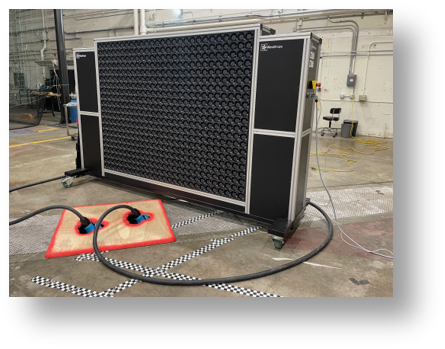
NASA's WindShaper Facility Enables Advanced UAV Testing
The Gist
NASA's WindShaper provides a programmable wind environment for testing UAVs and their autonomy systems.
Explain Like I'm Five
"Imagine a giant fan that can make wind do anything you want! NASA uses it to test flying robots and make sure they can fly even when it's windy."
Deep Intelligence Analysis
Transparency: This analysis is based solely on the provided source text. No external information was used. The analysis aims to provide an objective summary and assessment of the information presented in the source.
_Context: This intelligence report was compiled by the DailyOrbitalWire Strategy Engine. Verified for Art. 50 Compliance._
Impact Assessment
This facility allows for realistic simulation of wind conditions, crucial for developing robust UAV control systems. It supports research into low-speed and hovering flight.
Read Full Story on NASA AeronauticsKey Details
- ● The WindShaper features a 9’x7’ array of 1134 fans.
- ● It can generate wind speeds from 0 to 16 m/s (36 mph).
- ● The WindShaper's acceleration is 4 m/s², and deceleration is 2.5 m/s².
- ● Each fan is programmable via Python scripting.
Optimistic Outlook
The WindShaper's programmability enables rapid iteration and testing of UAV designs and control algorithms. This could accelerate the development of more reliable and autonomous UAVs.
Pessimistic Outlook
The limited size of the WindShaper may restrict testing of larger UAV platforms. The complexity of programming the fan array could present a barrier to entry for some researchers.

The Signal, Not
the Noise|
Get the week's top 1% of space-tech intelligence synthesized into a 5-minute read. Join 25,000+ aerospace insiders.
Unsubscribe anytime. No spam, ever.