Stellar Weather May Obscure Alien Radio Signals
The Gist
Stellar weather from distant stars may broaden and weaken potential alien radio signals, hindering detection by SETI.
Explain Like I'm Five
"Imagine trying to hear someone far away, but the wind is messing up their voice, making it hard to understand. Space weather can do the same to alien radio signals, making them harder to find!"
Deep Intelligence Analysis
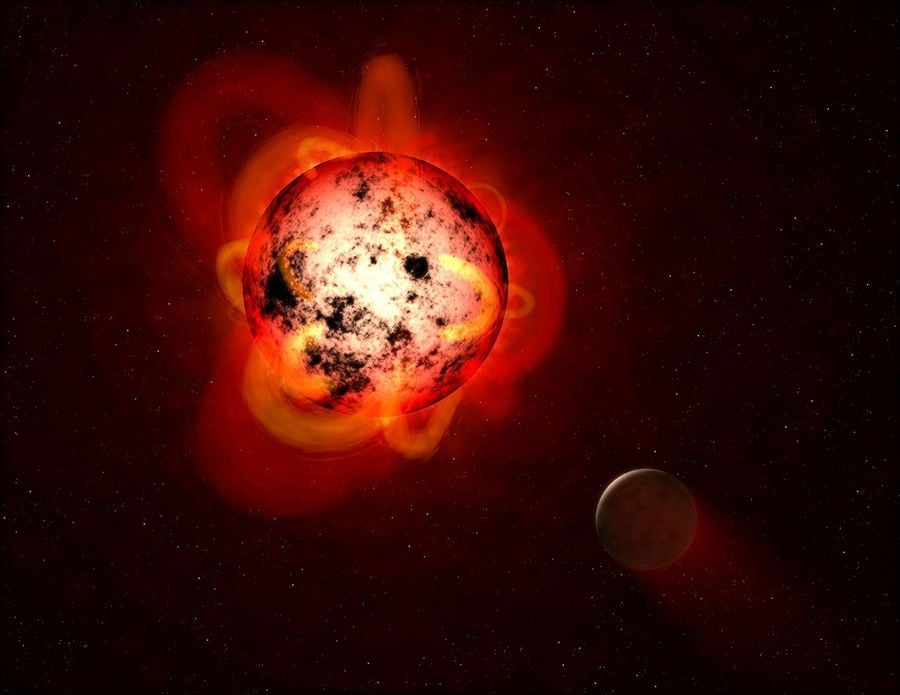
The study highlights that stellar weather can broaden a 1 Hz signal to 10 Hz or even 100 Hz, drastically reducing its power. The authors analyzed data from deep-space probes, including Mariner IV and Rosetta, to understand how our Sun's plasma distorts radio signals. They extrapolated these findings to other stars, considering factors like distance and stellar characteristics. Red dwarfs, which are common and often host potentially habitable exoplanets, are particularly prone to signal distortion due to the proximity of signals to the star.
These findings suggest that current SETI search parameters may be too restrictive, potentially overlooking signals distorted by stellar weather. Future SETI efforts may need to incorporate algorithms that account for signal broadening and consider the effects of stellar environments. This research underscores the complexity of searching for extraterrestrial intelligence and the need to refine search strategies to account for the challenges posed by stellar weather.
Transparency Statement: This analysis is based solely on the provided source article. No external information was used. The AI model (Gemini 2.5 Flash) was used to summarize and reformat the information for brevity and clarity. The analysis aims to provide an objective assessment of the article's content and its potential implications for the aerospace sector.
_Context: This intelligence report was compiled by the DailyOrbitalWire Strategy Engine. Verified for Art. 50 Compliance._
Impact Assessment
This research suggests that current SETI search parameters may be too narrow, potentially overlooking signals distorted by stellar weather. It highlights the need to consider stellar environment effects when searching for extraterrestrial intelligence.
Read Full Story on Universe TodayKey Details
- ● Stellar turbulence can broaden a 1 Hz signal to 10-100 Hz.
- ● Signal power drops significantly as frequency bandwidth increases.
- ● Red dwarfs, common stars with habitable exoplanets, are prone to signal distortion due to proximity.
Optimistic Outlook
Future SETI efforts could incorporate algorithms that account for signal broadening, increasing the chances of detecting faint, distorted signals. Understanding stellar weather patterns could refine search strategies and improve signal processing techniques.
Pessimistic Outlook
The distortion of signals by stellar weather could significantly reduce the likelihood of detecting extraterrestrial communications. The prevalence of red dwarfs, which exacerbate this effect, presents a challenge for finding habitable planets with detectable signals.

The Signal, Not
the Noise|
Get the week's top 1% of space-tech intelligence synthesized into a 5-minute read. Join 25,000+ aerospace insiders.
Unsubscribe anytime. No spam, ever.