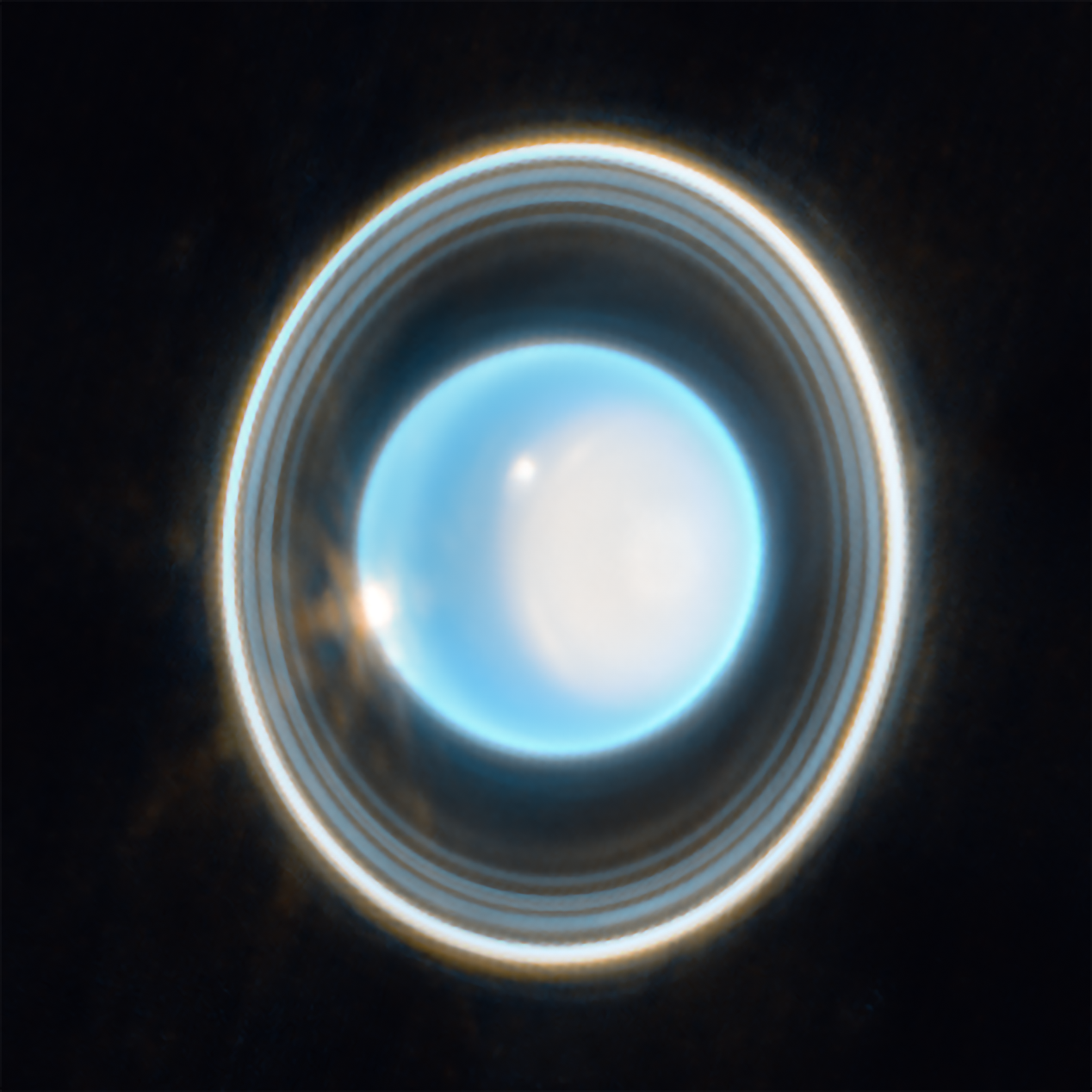
Hubble and Webb Telescopes Reveal Color Differences in Uranian Rings
The Gist
Observations from Hubble, Webb, and Keck telescopes show that Uranus's μ and ν rings have distinct colors and compositions, offering insights into their origins.
Explain Like I'm Five
"Uranus has rings like Saturn, but they're not all the same! Some are blue and icy, like a snowball, and others are red and dusty, like dirt. Scientists are using big telescopes to figure out where they came from."
Deep Intelligence Analysis
_Context: This intelligence report was compiled by the DailyOrbitalWire Strategy Engine. Verified for Art. 50 Compliance._
Impact Assessment
The discovery of compositional differences in Uranus's rings provides valuable clues about the formation and evolution of the Uranian system and similar planetary systems. Understanding the origins of these rings can shed light on the processes that shaped the outer Solar System.
Read Full Story on Universe TodayKey Details
- ● The μ ring appears blue and is made of icy particles.
- ● The ν ring appears red and contains 10–15% carbon-rich organics.
- ● The μ ring is likely sourced from the icy moon Mab.
- ● The ν ring's material likely comes from micrometeorite impacts on rocky bodies.
- ● The μ ring lies about 98,000 km from Uranus's cloud tops, while the ν ring lies about 67,000 km away.
Optimistic Outlook
Further studies of Mab and other Uranian moons could reveal more about the composition and dynamics of the outer Solar System. Future flyby missions could provide detailed images and data to enhance our understanding of these distant worlds.
Pessimistic Outlook
The faintness of the rings makes them challenging to study, limiting the amount of data that can be collected. The mystery surrounding Mab's composition and the origins of the rocky bodies sourcing the ν ring may remain unsolved for some time.

The Signal, Not
the Noise|
Get the week's top 1% of space-tech intelligence synthesized into a 5-minute read. Join 25,000+ aerospace insiders.
Unsubscribe anytime. No spam, ever.