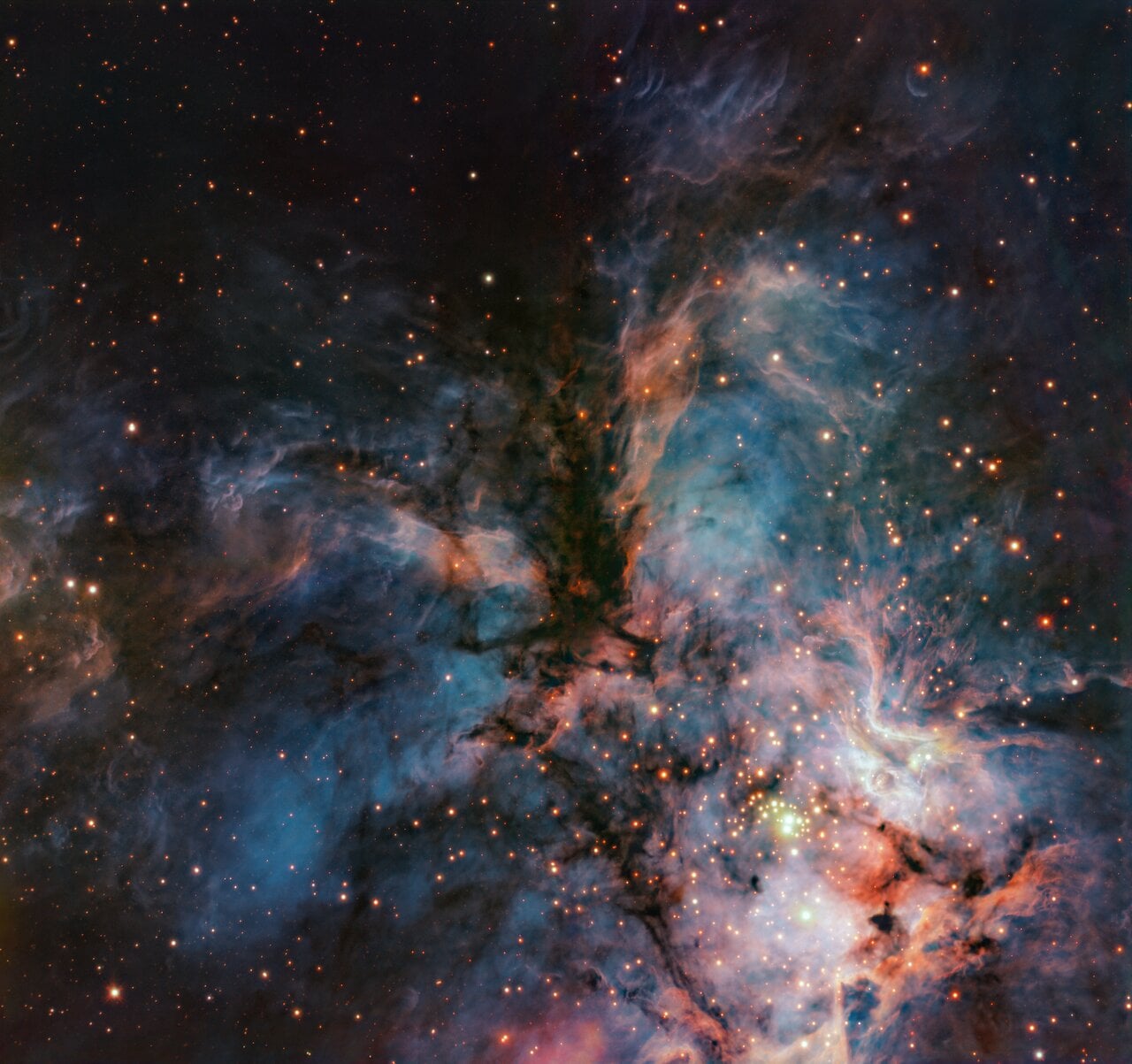
VLT Captures Image of "Cosmic Hawk" Nebula RCW 36
The Gist
The Very Large Telescope captured an image of the RCW 36 nebula, resembling a cosmic hawk, revealing newly forming stars and brown dwarfs.
Explain Like I'm Five
"Imagine a giant bird made of space dust! A telescope took a picture of it, showing baby stars and failed stars called brown dwarfs hiding inside."
Deep Intelligence Analysis
The study, led by astronomers from the Instituto de Astrofĩsica e Ciências do Espaço (IA) in Lisbon, focused on identifying the population of faint brown dwarfs within the nebula. HAWK-1's high sensitivity and adaptive optics allowed the team to overcome atmospheric interference and observe these substellar objects. The research, published in *Astronomy & Astrophysics*, provides valuable data for improving our understanding of brown dwarf formation and the dynamics of young star clusters.
The image not only showcases the beauty of the cosmos but also highlights the power of advanced astronomical instruments in uncovering the secrets of star formation. The ability to observe faint objects within dense nebulae is crucial for understanding the processes that govern the birth and evolution of stars and substellar objects. The RCW 36 image serves as a reminder of the ongoing exploration of the universe and the continuous advancements in astronomical technology.
_Context: This intelligence report was compiled by the DailyOrbitalWire Strategy Engine. Verified for Art. 50 Compliance._
Impact Assessment
The image and associated research provide valuable data for understanding brown dwarf formation. High-resolution imaging allows astronomers to penetrate dust clouds and observe faint objects.
Read Full Story on Universe TodayKey Details
- ● The RCW 36 nebula is located approximately 2,300 light-years away in the Vela Constellation.
- ● The image was acquired by the High Acuity Wide-field K-band Imager-1 (HAWK-1) on the VLT.
- ● The study identified faint brown dwarfs within the nebula.
- ● The research paper is titled "Substellar population of the young massive cluster RCW 36 in Vela."
Optimistic Outlook
Advanced imaging technology like HAWK-1 enables deeper exploration of star-forming regions. This leads to a better understanding of stellar and substellar object formation.
Pessimistic Outlook
Observing faint objects requires sophisticated instruments and techniques. Atmospheric interference can still pose challenges despite adaptive optics.

The Signal, Not
the Noise|
Get the week's top 1% of space-tech intelligence synthesized into a 5-minute read. Join 25,000+ aerospace insiders.
Unsubscribe anytime. No spam, ever.