BREAKING: • Starlink Mini May Integrate Battery for Enhanced Portability • DESI Data Provides New Consistency Test for ΛCDM Model • DESI DR2 Data Favors Standard ΛCDM Cosmology Over R_h=ct Model • DESI Data Suggests Dynamical Dark Energy • skysurvey: A Python Package for Simulating Transient Sky Events
Starlink Mini May Integrate Battery for Enhanced Portability
Satellites May 26
V
The Verge Space // 2026-05-26

Starlink Mini May Integrate Battery for Enhanced Portability

THE GIST: SpaceX firmware hints at a Starlink Mini with an integrated battery, enhancing portability and ease of use.

IMPACT: An integrated battery would improve the Starlink Mini's portability and user experience. This could expand its use cases for mobile users and emergency responders, making satellite internet more accessible.
Optimistic
Pessimistic
ELI5
Deep Dive // Full Analysis
DESI Data Provides New Consistency Test for ΛCDM Model
Satellites May 26
arXiv Cosmology // 2026-05-26

DESI Data Provides New Consistency Test for ΛCDM Model

THE GIST: DESI data offers a calibration-free consistency test for the spatially flat ΛCDM model using baryon acoustic oscillation (BAO) measurements.

IMPACT: Consistency tests are crucial for validating cosmological models. This new test strengthens the reliability of the flat ΛCDM model.
Optimistic
Pessimistic
ELI5
Deep Dive // Full Analysis
DESI DR2 Data Favors Standard ΛCDM Cosmology Over R_h=ct Model
Satellites May 26
arXiv Cosmology // 2026-05-26

DESI DR2 Data Favors Standard ΛCDM Cosmology Over R_h=ct Model

THE GIST: Joint analysis of DESI DR2 data favors the standard ΛCDM cosmological model over the alternative R_h=ct framework.

IMPACT: Validating cosmological models is crucial for understanding the universe's evolution. This study provides further support for the standard ΛCDM model.
Optimistic
Pessimistic
ELI5
Deep Dive // Full Analysis
DESI Data Suggests Dynamical Dark Energy
Satellites May 26
arXiv Cosmology // 2026-05-26

DESI Data Suggests Dynamical Dark Energy

THE GIST: Analysis of DESI DR2 data favors dynamical dark energy models over the standard cosmological constant.

IMPACT: Understanding the nature of dark energy is a fundamental challenge in cosmology. Evidence for dynamical dark energy could reshape our understanding of the universe's expansion.
Optimistic
Pessimistic
ELI5
Deep Dive // Full Analysis
skysurvey: A Python Package for Simulating Transient Sky Events
Satellites May 26
arXiv Cosmology // 2026-05-26

skysurvey: A Python Package for Simulating Transient Sky Events

THE GIST: skysurvey is a new pure Python package designed for simulating astrophysical transients as observed by surveys.

IMPACT: Accurate simulation of astronomical observations is crucial for measuring event rates, analyzing population properties, and validating pipelines. skysurvey enables fast and easy implementation of complex population modeling.
Optimistic
Pessimistic
ELI5
Deep Dive // Full Analysis
New Galaxy Cluster Discovered Behind the Zone of Avoidance
Satellites May 26
arXiv Cosmology // 2026-05-26

New Galaxy Cluster Discovered Behind the Zone of Avoidance

THE GIST: A new massive galaxy cluster, SRGe CL0512.7+3712, has been discovered in the Zone of Avoidance using SRG/eROSITA data.

IMPACT: This discovery highlights the incompleteness of the local Universe's galaxy cluster census due to obscuration by the Milky Way. Further searches in the ZoA may reveal more hidden clusters.
Optimistic
Pessimistic
ELI5
Deep Dive // Full Analysis
GOES-East Data Used to Quantify Atmospheric CO2
Satellites May 26
arXiv Earth & Planetary // 2026-05-26

GOES-East Data Used to Quantify Atmospheric CO2

THE GIST: GOES-East data is leveraged to estimate dry-air column CO2 mole fraction using a physics-guided neural network.
IMPACT: This research demonstrates the potential of using existing satellite missions for greenhouse gas monitoring. The high temporal and spatial resolution of GOES-East offers a unique perspective on atmospheric CO2 variability.
Optimistic
Pessimistic
ELI5
Deep Dive // Full Analysis
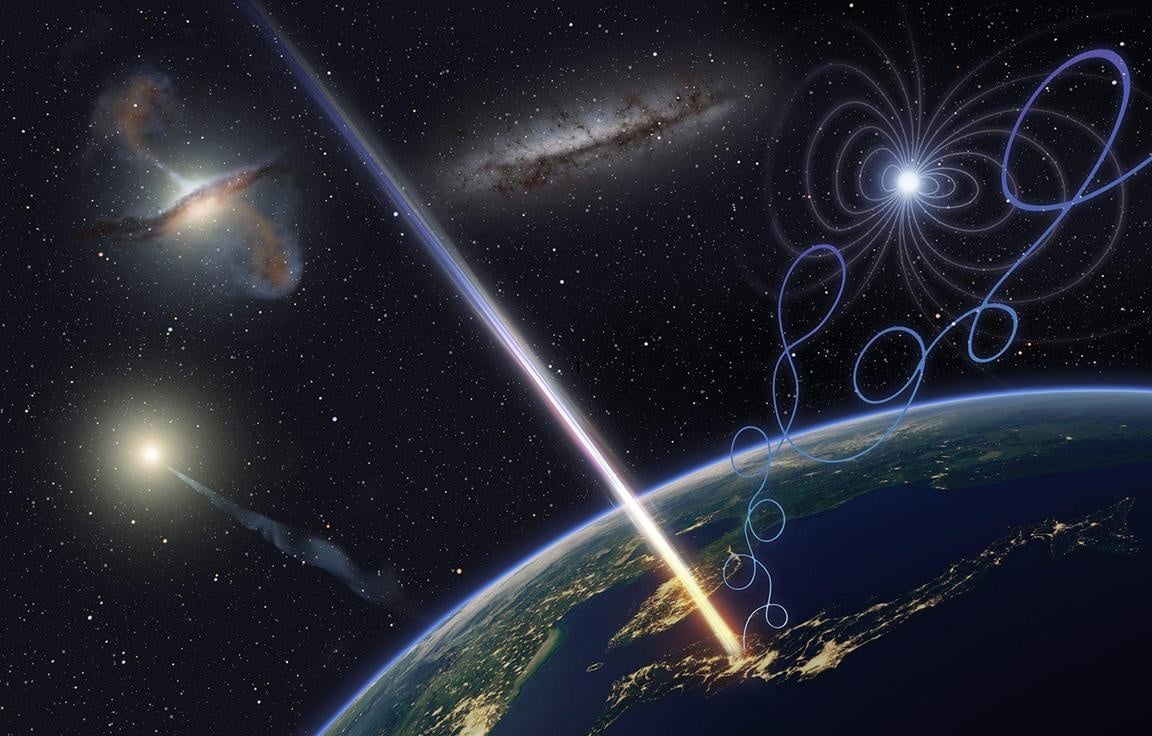
Ultrahigh-Energy Cosmic Rays May Originate from Ultraheavy Nuclei
Satellites May 25
Universe Today // 2026-05-25

Ultrahigh-Energy Cosmic Rays May Originate from Ultraheavy Nuclei

THE GIST: A new study suggests ultrahigh-energy cosmic rays, like the Amaterasu particle, may consist of atomic nuclei heavier than iron.

IMPACT: Understanding the origin of ultrahigh-energy cosmic rays provides insights into extreme astrophysical events and the composition of intergalactic space. Identifying the source and nature of these particles could refine models of cosmic ray acceleration and propagation.
Optimistic
Pessimistic
ELI5
Deep Dive // Full Analysis
Astronaut Captures Stunning Sunset from ISS Orbit
Satellites May 25
Space.com // 2026-05-25

Astronaut Captures Stunning Sunset from ISS Orbit

THE GIST: NASA astronaut Chris Williams photographed a vibrant sunset from the International Space Station, highlighting Earth's atmospheric beauty.

IMPACT: The image underscores the unique perspective offered by space-based observation, reminiscent of the influential 'Earthrise' photo. It also highlights the ISS's role as a long-term platform for scientific observation and international collaboration.
Optimistic
Pessimistic
ELI5
Deep Dive // Full Analysis
gwcosmo Pipeline Achieves 1000x Speedup for Dark Siren Cosmology
Satellites May 25
arXiv Cosmology // 2026-05-25

gwcosmo Pipeline Achieves 1000x Speedup for Dark Siren Cosmology

THE GIST: An upgraded gwcosmo pipeline leverages GPU vectorization for a 1000x speedup in dark siren cosmological inference.

IMPACT: Efficient cosmological inference from gravitational waves is crucial for understanding the universe's expansion and fundamental parameters. This speedup enables analyses of larger datasets, improving the precision of cosmological measurements.
Optimistic
Pessimistic
ELI5
Deep Dive // Full Analysis
GEODES Identifies Long-Period Exoplanet Companions via Gaia Data
Satellites May 25
arXiv Earth & Planetary // 2026-05-25

GEODES Identifies Long-Period Exoplanet Companions via Gaia Data

THE GIST: GEODES uses Gaia data to identify and characterize exoplanets and stellar companions accelerating their host stars.

IMPACT: Validating exoplanet candidates from Gaia data is crucial for understanding planet demographics and refining future search strategies. GEODES provides a framework for efficiently identifying promising candidates for further observation and characterization.
Optimistic
Pessimistic
ELI5
Deep Dive // Full Analysis
Accretion's Impact on Water in Planet-Forming Disks: JWST Observations
Satellites May 25
arXiv Earth & Planetary // 2026-05-25

Accretion's Impact on Water in Planet-Forming Disks: JWST Observations

THE GIST: Models using JWST data show accretion luminosity strongly correlates with increased water line flux in planet-forming disks.

IMPACT: Understanding the relationship between accretion and water abundance is crucial for understanding planet formation. JWST observations provide key insights into the composition of forming planets.
Optimistic
Pessimistic
ELI5
Deep Dive // Full Analysis
Previous
Page 1 of 75
Next
```